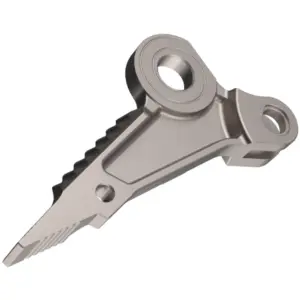
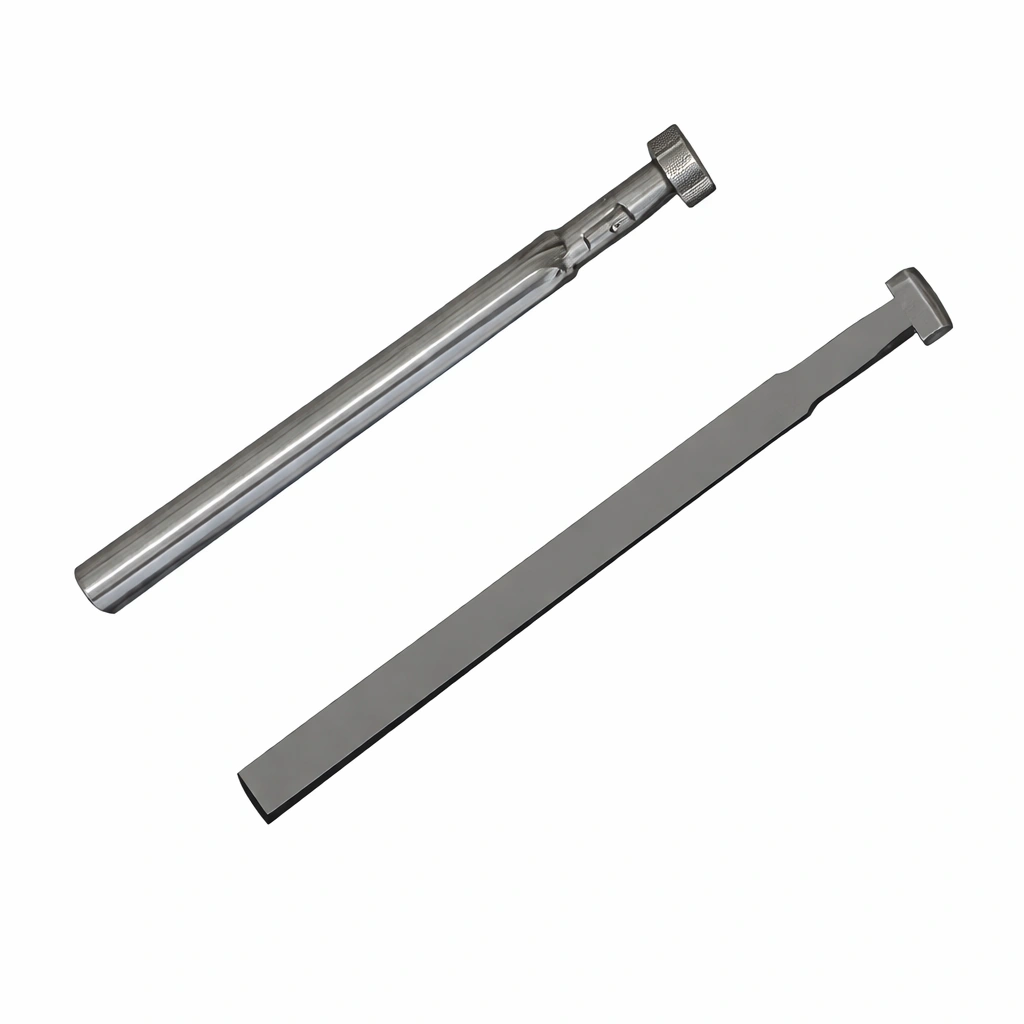
The counter wedge is an essential part of the Darda splitting system. It works in tandem with the central wedge to transmit the splitting force evenly and maximize rock or concrete separation.
Design:
- Function: It acts as a counter-force element. When the central wedge is driven into the hole by hydraulic pressure, the counter wedge receives the force from the material and pushes back, creating a uniform split along the crack or drilled hole.
- Positioning: Inserted in the drilled hole opposite or in alignment with the central wedge depending on the splitter type.
- Design: Typically a robust, tapered wedge designed to withstand high compressive and shear forces during splitting.
Applications:
- Mining and Quarrying -Works with central wedge to safely split large rocks into manageable blocks; Allows controlled separation of stones without blasting.
- Civil Engineering and Demolition -Used to demolish concrete slabs, walls, and foundations safely; Ideal for controlled removal where surrounding structures must remain intact.
- Tunnel and Underground Excavation -Helps in precise rock splitting in confined spaces; Reduces vibration and dust compared to explosive methods.
- Environmentally Sensitive Work -Underwater splitting and urban areas benefit from the reduced noise and vibration provided by Darda splitters using both wedges.
Materials:
- Tool Steels -Cr-Mo steel alloys or high-speed steels (HSS) for high strength and toughness; Heat-treated to achieve high hardness (5060 HRC) while maintaining impact resistance.
- Surface Enhancements -Nitride or carbide coatings for wear resistance;Chrome or nickel plating for corrosion protection, especially in wet or marine environments.
- Extreme Applications -Tungsten carbide tips or inserts for highly abrasive rock types;High-strength stainless steel for underwater or corrosive environments.
Configurations:
- Splitter Model: C2, C4, C9, C10S or C12
- Long, Narrow, Narrow Jura, Narrow Jura Thick, Wide, Wide and Long, Wide and Extra Long