
Pumps
Pumps on this page move water, sludge, and slurry off a working site — trench and pit dewatering, tunnel sumps, storm cleanup, and industrial fluid transfer. Two families cover almost all of it. Electric submersible drainage pumps such as the Atlas Copco WEDA D Series and the abrasion-resistant WEDA L Series slurry pump drop straight into the hole and run on line power. Air-driven pneumatic diaphragm pumps like the Atlas Copco DOP 15, and the CP 0020 pneumatic submersible pump, run off the air compressor already on the truck, self-prime, and take no harm from running dry. Both families sit under construction tools. Ships from Denver.
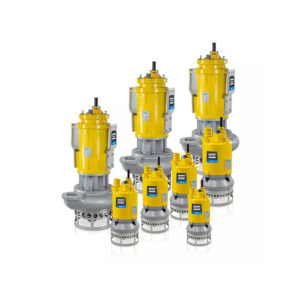
Submersible Drainage and Slurry Pumps
Atlas Copco splits the WEDA range by what is in the water — D for drainage, S for sludge, L for slurry — so the hydraulics and wear parts match the media instead of a general-purpose pump fighting grit. Aluminum-alloy housings keep the units light enough for one person to reset between pits, and the motor is cooled all the way around rather than relying on submergence alone. See the full drainage and slurry range and the Atlas Copco WEDA line.
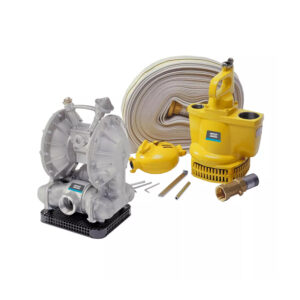
Pneumatic Diaphragm and Sump Pumps
An air diaphragm pump has no rotating seal or impeller in the fluid path, so grit, sludge, and small solids that would wreck a centrifugal pump pass straight through. It self-primes, dead-heads against a closed valve, and runs dry all shift without damage — which is why crews use one as a pneumatic sump pump in a pit that fills and empties on no schedule. See the air diaphragm pumps and the Atlas Copco DOP range.
Electric or Air Driven?
Decide on what the site already has. With line power or a generator and a pit that runs steadily, an electric submersible moves the most water for the money. With a compressor running, no power at the hole, or an atmosphere that rules out an electric motor, go air: nothing to burn out, no cord to keep clear of the water, and the pump stalls harmlessly instead of overheating. Plenty of crews keep both and use the air pump for cleanout.
Clean Water, Sludge, or Slurry
Solids content drives the choice more than flow does. Clear trench water suits a straight drainage pump. Muck, drilling fines, and concrete washout need slurry hydraulics with harder wet-end parts. Polluted, viscous, or intermittent fluid favors a diaphragm pump. Undersizing solids handling is what kills pumps — a clogged impeller shows up as a dead pump and a flooded excavation the next morning.
Common Questions
Do you carry a pneumatic sump pump? Yes — the CP 0020 is an air-driven submersible that runs off shop or jobsite air, and an air diaphragm pump does the same job from outside the pit. Both need a compressor sized to the tool.
What is a dewatering pump? Any pump used to take standing or inflowing water out of an excavation, trench, tunnel, or pit so work can continue. On construction sites that usually means a submersible — see the dewatering pump page.
Do you sell hydraulic submersible pumps? Not in this category. What we stock is electric submersible and air-driven. If you are already running a hydraulic power pack on site, call with your flow and pressure and we will tell you what fits.
Which pump handles sludge and solids? The WEDA L slurry pump is built for clean or dirty water carrying small solids, and a diaphragm pump handles viscous and polluted fluid that would blind an impeller.