
Spec the Right Chipping Hammer in Five Minutes
Four decisions – stroke, handle, shank, air – separate the right tool from an expensive mistake. This guide walks a working buyer through all four, with real numbers from the 26 pneumatic chipping hammers we stock.
Start With the Job, Not the Catalog
A chipping hammer is a handheld pneumatic tool that uses a free-flying piston to deliver 1,500-3,200 blows per minute for scaling, chipping, and light demolition. The tool is a system: hammer, steel, and air. The work you do most decides the spec. Find your job below – each card gives you the straight answer, then the rest of the page shows the why.
Weld cleanup & scaling
Slag, spatter, rust, and mill scale on structural steel. Speed and control beat raw power.
Run a 2 in. stroke, ~13 lb, 2,400 BPM. Fast, light blows clean without gouging.Concrete & masonry
Chipping high spots, keyways, mortar joints, and demo too small for a paving breaker.
Run a 4 in. stroke, 16-18.25 lb, 1,500-1,800 BPM. Slower, harder hits break material.Refractory & boiler work
Lining tear-out and repair in tight quarters, often overhead, shift after shift.
Run a 3 in. stroke in-line body – slim, controllable, and easy to work at any angle.General contractor fleet
One hammer that covers form stripping, chipping, and the odd demo callout.
Run a 3 in. stroke D-handle, .580 hex – the most versatile single-tool spec.Four Decisions, In Order
Work top to bottom. Each choice narrows the catalog until exactly the right tool is left.
Stroke length
The core trade-off: shorter stroke = faster, lighter blows; longer stroke = slower, harder blows. Same CP 4123, three personalities:
| 2 in. | 2,400 BPM – scale & clean |
| 3 in. | 1,920 BPM – all-around |
| 4 in. | 1,500 BPM – break material |
Handle style
How you’ll hold it for six hours matters more than any spec sheet number.
| D-handle | Full-hand grip; lean in on down & horizontal work |
| In-line | Slim straight body; close quarters, any angle |
| 4-bolt | Bolted back head for rigid, sustained duty |
Shank & retainer
Your steel is the system. Buy the chuck that matches the steel you already own.
| .580 hex | The common contractor standard |
| .680 rnd | Rotates free; bushing & scaling heads |
| Retainer | Oval-collar, ball-type, or bolt-on ball – match your steel’s collar |
Air & oil
Modest demand, zero forgiveness. Undersized air starves the tool; dry air destroys it.
| 20-36 | CFM @ 90 psi, by model |
| 50 CFM | Compressor for one tool, continuous |
| Oiler | Inline oiler on the whip – always |
How a Pneumatic Chipping Hammer Works
A chipping hammer turns compressed air into thousands of hammer blows a minute. The operator does not swing it – a free-flying piston inside the cylinder does the striking. It is one simple cycle, repeated dozens of times every second. The exploded view below shows every major component in a CP 4130 class tool, from the throttle lever to the tool retainer.
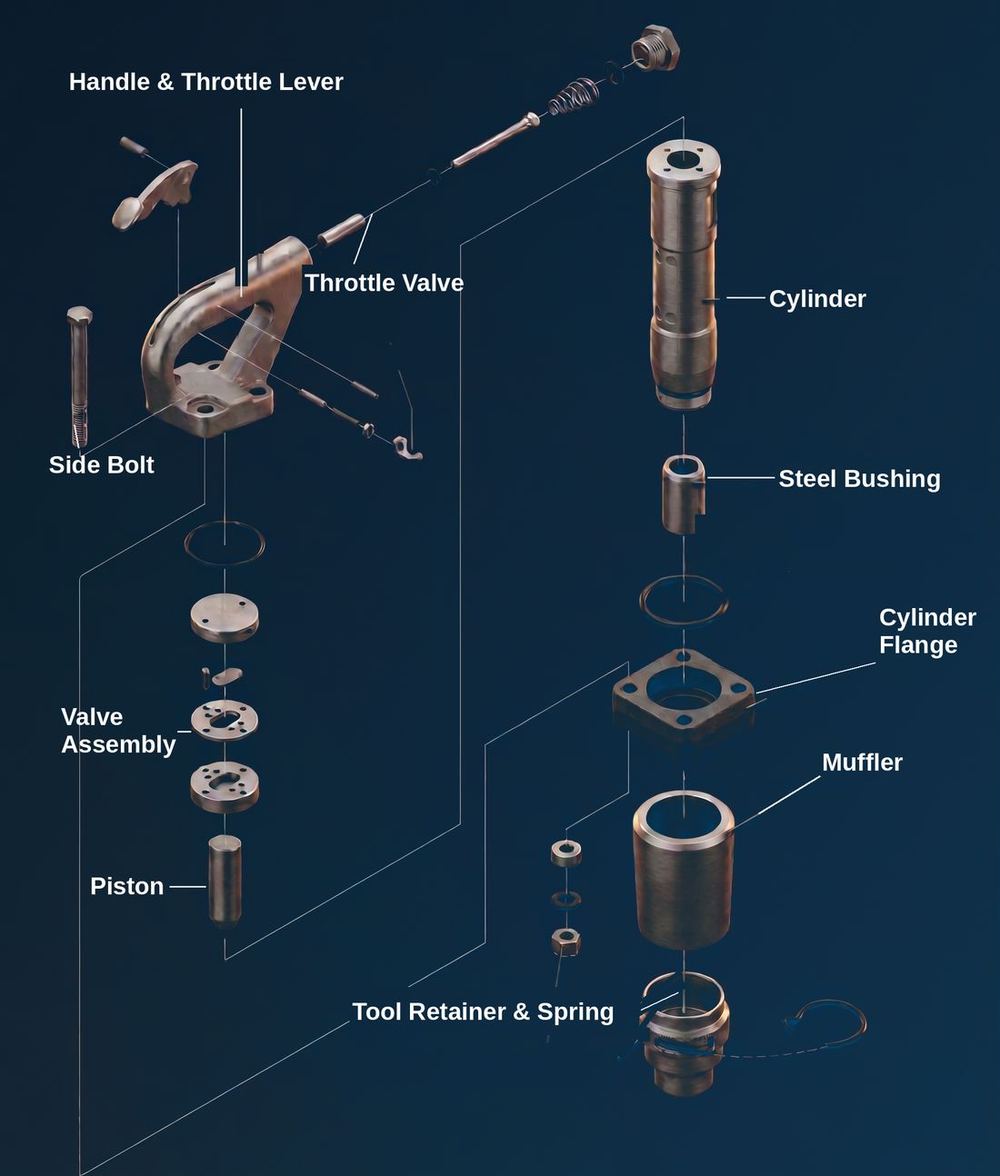
Exploded view, CP 4130 class chipping hammer. Illustration for reference only – not to scale.
The operating cycle
- Air enters at the handleCompressed air at 90 psi passes the throttle valve when the operator squeezes the throttle lever.
- The valve assembly directs the airA small automatic valve ports incoming air alternately to the back and front of the piston.
- The piston drives forwardAir accelerates the free piston down the cylinder. Connected to nothing, all of its mass and velocity become impact energy.
- The piston strikes the tool shankIts forward face hits the anvil end of the chisel or spade, delivering one blow into the work. The steel bushing keeps the shank aligned.
- The valve flips and the piston returnsAs the piston passes the exhaust ports, pressure shifts, the valve reverses, and air drives the piston back to start the cycle again. Exhaust air exits through the muffler.
What you are looking at
Four Hammers That Cover Every Job Above
Every model ships free, takes .580 in. hex or .680 in. round steel, and is backed by parts we keep on the shelf.
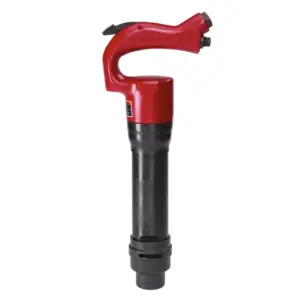
CP 4123
Best for: buyers who want one proven D-handle platform and the freedom to spec the stroke to the job – the lightest tools in this lineup.
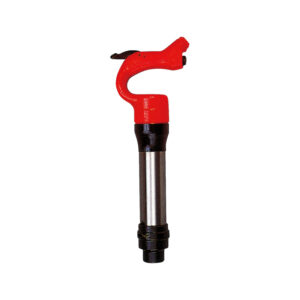
Tamco/Toku THA-4B
Best for: concrete and masonry chipping on a budget – maximum per-blow energy from a long stroke in a slim in-line body, at the lowest entry price here.
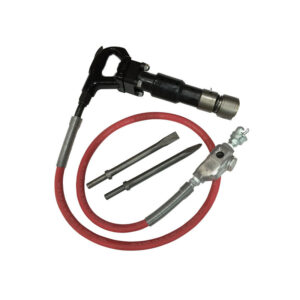
Texas Pneumatic TXCH3
Best for: refractory and industrial crews that want a domestic in-line tool with a standard or rigid 4-bolt back head and a ball-retainer option.
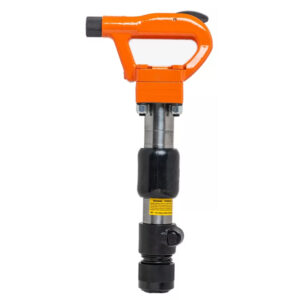
APT M43
Best for: fleets that rebuild their tools – a 21 lb 4-bolt D-handle with all three retainer styles and deep U.S. aftermarket parts support.
The Full Spec Matrix
Straight from the spec tables on each product page – compare every configuration before you call.
| Model / config | Style | Stroke | Weight | BPM | CFM @ 90 psi | Length | Air inlet |
|---|---|---|---|---|---|---|---|
| CP 4123 (2 in.) | D-handle | 2 in. | 13 lb | 2,400 | 25 | 13 in. | 3/8 F NPT |
| CP 4123 (3 in.) | D-handle | 3 in. | 15 lb | 1,920 | 26 | 15 in. | 3/8 F NPT |
| CP 4123 (4 in.) | D-handle | 4 in. | 16 lb | 1,500 | 27 | 16 in. | 3/8 F NPT |
| Toku THA-4B | In-line | 4 in. | 18.25 lb | 1,800 | 33 | 19 in. | 3/8 F NPT |
| TXCH3 (standard) | In-line | 3 in. | 17 lb | 1,650 | 33 | 17 in. | 7/8-24 F |
| TXCH3 (4-bolt) | In-line | 3 in. | 19 lb | 1,650 | 34 | 15 in. | 7/8-24 F |
| APT M43 (4-bolt) | D-handle | 3 in. | 21 lb | 1,650 | 33 | 17 in. | 7/8-24 F |
The Complete Order, One PO
A hammer that arrives without steel, oil, or the right whip sits in the gang box. Five line items make it a working system on day one.
The hammer
Spec’d above – chuck size and retainer matched to your steel.
Chipping hammersSteel for the work
Chisels 1-1/2 to 3 in., moil points, spades, bushing tools – 9 to 120 in. lengths, every shank/collar combo.
Tool steel & chiselsWhip with inline oiler
1/2 in. ID whip with a line oiler between hose and tool – the cheapest life insurance a pneumatic tool can get.
Hoses, oil & lubeRock drill oil
Keep the oiler filled with pneumatic tool and rock drill oil. Running dry wears the piston, valve, and cylinder – the expensive parts.
Pneumatic tool oilSpare retainer springs
Springs are consumables. A universal chipping hammer spring runs $5 – crews buy the 25-pack.
Parts & accessoriesBuilt for Buyers Who Keep Tools Running
Chicago Pneumatic
One of the longest-running chipping and demolition lineages in the industry – the CP 4123 family anchors the class.
Tamco / Toku
Japanese manufacturer with a deep export catalog of industrial chipping, riveting, and demolition tools.
Texas Pneumatic
Complete domestic line of pneumatic chipping tools with strong field-replacement support.
American Pneumatic Tools
Long-established U.S. manufacturer with deep aftermarket parts support for rebuild-minded fleets.
Buyer Questions, Answered Straight
What size chipping hammer do I need?
What is the difference between .580 hex and .680 round shanks?
How much air does a chipping hammer need?
Chipping hammer, paving breaker, or needle scaler – which do I need?
Which retainer type should I choose?
What should I order with a new chipping hammer?
Ready to Spec It? We Do This All Day.
Tell us the job – we will match the hammer, steel, retainer, and air setup in one call, and Chipping Hammers ship free to the lower 48.