
Match the DTH Hammer to the Hole – and the Air You’ve Got
Five decisions pick a down-the-hole hammer: hole diameter, the air package that feeds it, foot-valve or not, the shank that ties the hammer to its bit, and valved vs valveless design. This guide walks all five with manufacturer-verified specs across the Mincon, Rockmore, and Rock Hog lines we sell – so the hammer that ships matches your rock, your rig, and your compressor.
Category Data Plate
Ranges span all three catalogs. Small 3-4 in. hammers run ~130-300 CFM; 8 in. ~900-1,300 CFM; 10-24 in. large-diameter 1,500-9,000+ CFM. Low-pressure hammers start at 87 psi.
Start With the Job, Not the Catalog
A down-the-hole (DTH) hammer is a pneumatic percussion tool that rides at the bottom of the drill string, directly behind the bit, using compressed air to drive a piston that hammers the bit while the rig rotates and feeds it – so impact energy stays strong at any depth for fast, straight holes in hard rock. Every hammer we sell is a variation on that one machine; what changes is size, air appetite, and how the shank ties it to the bit. Find your job below and jump to the hammers built for it.
Deep, straight 4-8 in. holes through rock for wells, loop fields, and dewatering – where hole straightness at depth is everything.
Straight answer: a 5 or 6 in. hammer (MP50/MP60 class) sized to your compressor is the workhorse; step to 8 in. for high-volume wells.Anchor, tieback, and micropile holes 4-12 in. in rock – often cased, often in tight or urban sites.
Straight answer: a 6 to 8 in. hammer covers most micropile work; go large-diameter (MP100 and up) for caissons.Production drilling 3.5-10 in. for blasting, presplitting, and bench work – meters per hour drives the cost.
Straight answer: run the biggest high-pressure hammer your compressor supports – more CFM and psi is more penetration.Ground rods, guardrail and sign anchors, seismic shot holes, rock dowels – 3-4.5 in. holes off a smaller rig.
Straight answer: a 3 or 4 in. hammer (MP30/MP35/MP4H) runs on a modest 130-300 CFM package.Blasthole and caisson drilling 10-24 in. on track rigs with big compressor packages and boosters.
Straight answer: the MP100 through MP240 cover 10 to 24 in.; ask us to spec the air package and booster.The Five Decisions, In Order
Work these top to bottom and the catalog picks itself. Air figures are typical class ranges – exact demand rises with operating pressure.
The hole you have to drill sets the hammer size class. Bits run a little larger than the hammer body.
| 3-3.5 in | 3 in hammer |
| 4-5 in | 4 in hammer |
| 5-6 in | 5 in hammer |
| 6-7 in | 6 in hammer |
| 8-10 in | 8 in hammer |
| 10-24 in | large-diameter |
Air is the governing constraint. Size the compressor to the hammer, in CFM and psi both.
| 3 in | 130-190 CFM |
| 4 in | 150-300 CFM |
| 5 in | 300-650 CFM |
| 6 in | 450-800 CFM |
| 8 in | 900-1,300 CFM |
| 10 in+ | 1,500-5,000+ CFM |
High-pressure hammers drill faster if your air can feed them; low-pressure models suit smaller or older compressors.
| High | 350-500 psi, max rate |
| Low | 87-145 psi, light rigs |
| Booster | lifts psi for deep holes |
The suffix tells you: DH/QL/SD run a foot valve; MQ/MC do not. It changes air use and hole cleaning.
| Foot valve | better flush & drawback, wet holes |
| No foot valve | simpler, saves air, dry/hard rock |
The shank designation ties hammer to bit – and it is an industry standard shared across brands.
| DHD3.5 | 3 in class |
| DHD340 | 4 in class |
| QL50/DHD350 | 5 in class |
| QL60/DHD360 | 6 in class |
| QL80/DHD380 | 8 in class |
Air Demand by Hammer Size Class
The two most common DTH mistakes: buying too little hammer for the hole, and feeding it too little air. Find your hole size, then make sure the compressor delivers the CFM – at the pressure the hammer needs.
Class ranges compiled from Mincon, Rockmore, and Rock Hog published data; demand climbs with operating pressure and altitude. Above 8 in., packages are typically 900-1,300 CFM for a single 8 in. hammer and 1,500 CFM and up (often with a booster) for 10-24 in. hammers.
One Right Hammer Per Size Class
Six Mincon hammers – the DTH line we stock and can ship today – cover every hole from 3.5 to 12 inches, with the MP120 through MP240 continuing to 24 in. Prefer Rockmore or Rock Hog? We sell those lines too, and the size classes and shanks map straight across – ask for a quote on any of them. Specs are manufacturer figures; all DTH hammers are quoted (freight-shipped), so use the buttons to see the tool or request pricing.
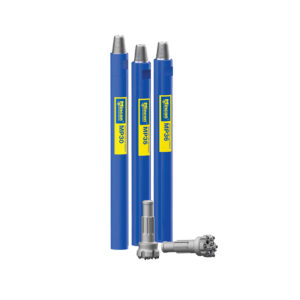
Mincon MP35-DH – 3 in class
Best for: shallow anchors, seismic shot holes, ground rods and utility holes off a modest compressor.
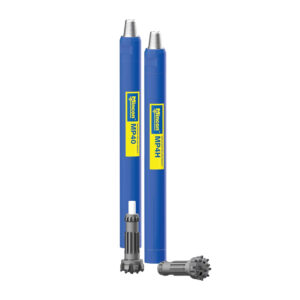
Mincon MP4H-DH – 4 in class
Best for: 4-5 in. construction, quarry, and presplit holes – the most common general-purpose class.
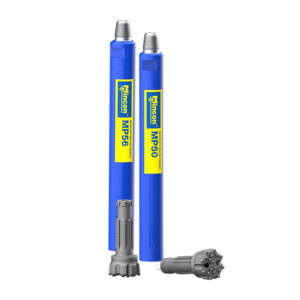
Mincon MP50-QL – 5 in class
Best for: 5-6 in. water well, geothermal, and foundation holes; available with or without foot valve (MP50/MQ50).
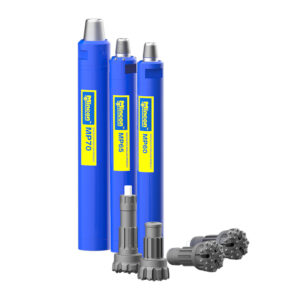
Mincon MP60-QL – 6 in class
Best for: 6-7 in. quarry production, deep water wells, and geothermal loop fields; DHD360 (MP6H) also stocked.
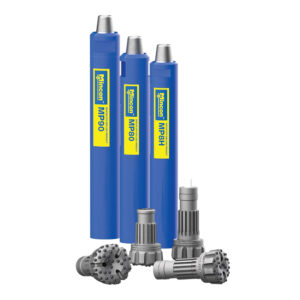
Mincon 8DH / MP80 – 8 in class
Best for: 8-10 in. deep blastholes, large water wells, and mining production; MQ85 available with no foot valve.
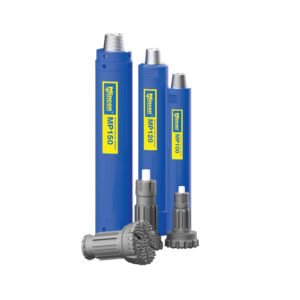
Mincon MP100-SD – 10 in class
Best for: large-diameter blastholes and caissons; step up to MP120 (12-15 in.), MP150, MP180, and MP240 (to 24 in.).
How a DTH Hammer Works
A down-the-hole hammer does the percussion at the bottom of the hole instead of at the surface. Compressed air travels down the drill pipe and drives a free-flying steel piston that hammers the drill bit directly; the rig only rotates and feeds the string. Because the hammer rides right behind the bit, its impact energy does not fade as the hole gets deeper – the reason DTH drilling stays fast and straight where top-hammer drills lose energy down the rod. The cutaway shows the air path through a typical high-pressure hammer.
Schematic cutaway of a high-pressure DTH hammer. For reference only – not to scale; exact port and valve layout varies by model and by valved vs valveless design.
The operating cycle
- Air travels down the drill stringCompressed air runs down the drill pipe into the backhead, past a check valve that stops water and cuttings from flooding back up the string when the air shuts off.
- The distributor ports air to the pistonThe air distributor and inner cylinder route air alternately to the top and bottom of a free-flying steel piston – dozens of cycles every second.
- The piston hammers the bitThe piston strikes the shank of the drill bit directly. Because the hammer sits at the bottom of the hole, that impact reaches the rock undiminished no matter how deep you drill.
- Exhaust air flushes the holeSpent air escapes through ports in the bit face and blows the cuttings up the annulus – the gap between drill pipe and hole wall – keeping the face clean for the next blow.
- The rig rotates and feedsThe rig slowly rotates the whole string and pushes down; the hammer only percusses. Rotation indexes the bit so its carbide buttons always strike fresh rock.
What you’re looking at
The Full Line, One Table
Representative DTH hammers across all three lines we sell, grouped by size class. Weights are manufacturer figures (hammer only, less bit); air is the typical class range. Mincon models link to the product page; Rockmore and Rock Hog are sold to order – call for a quote.
| Model | Brand | Hole size | Shank | Weight | Air, CFM (typ.) | Foot valve |
|---|---|---|---|---|---|---|
| 3 in class – holes ~3.0-3.5 in. | ||||||
| Mincon MP30-DH | Mincon | 3-3.5 in | IR3.5 / DHD3.5 | 49 lb | 130-190 | Yes |
| Mincon MP35-DH | Mincon | 3.5-4.1 in | DHD3.5 | 54 lb | 130-190 | Yes |
| Rockmore ROK 250 | Rockmore | 3.0-3.5 in | RM250 | 30 lb | 130-190 | Yes |
| Rockmore ROK 350 | Rockmore | 3.7-4.1 in | IR3.5 | 54 lb | 130-190 | Yes |
| Rock Hog RH35R9HP | Rock Hog | 3.5-4.25 in | 305 (DHD3.5) | 56 lb | 150 | Valveless |
| 4 in class – holes ~4.0-5.1 in. | ||||||
| Mincon MP4H-DH | Mincon | 4.3-5.1 in | DHD340 | 85 lb | 150-300 | Yes |
| Mincon MP40-MQ | Mincon | 4.3-5.1 in | MQ40 | 96 lb | 150-300 | No |
| Rockmore ROK 400 | Rockmore | 4.3-4.9 in | IR340A | 71 lb | 150-300 | Yes |
| Rock Hog RH40R9HP | Rock Hog | 4.0-5.1 in | 340 | 82 lb | 150 | Valveless |
| Rock Hog RH45Q9HP | Rock Hog | 4.5-5.1 in | Q40 (QLX40) | 112 lb | 150 | Valveless |
| 5 in class – holes ~5-6 in. | ||||||
| Mincon MP50-QL | Mincon | 5-6 in | QL50 | 122 lb | 300-650 | Yes |
| Mincon MP56-DH | Mincon | 5.5-6 in | DHD350 / IR350 | 148 lb | 300-650 | Yes |
| Mincon MC55 | Mincon | 5.5-6 in | MC51 | 146 lb | 300-650 | No |
| Rockmore ROK 550A | Rockmore | 5.5-6 in | QL50 | 133 lb | 300-650 | Yes |
| Rock Hog RH50Q1HP | Rock Hog | 5-6 in | QL5 (QL50) | 143 lb | 150-250 | Valveless |
| 6 in class – holes ~6-7 in. | ||||||
| Mincon MP60-QL | Mincon | 6-8 in | QL60 | 185 lb | 450-800 | Yes |
| Mincon MP6H-DH | Mincon | 6-8 in | DHD360 | 210 lb | 450-800 | Yes |
| Mincon MQ68 | Mincon | 6-8 in | QL60 | 187 lb | 450-800 | No |
| Rockmore ROK 600A | Rockmore | 6.1-7 in | QL60 | 168 lb | 450-800 | Yes |
| Rock Hog RH61Q1HP | Rock Hog | 6-7 in | QL6 (QL60) | 215 lb | 450 | Valveless |
| 8 in class – holes ~7.9-10 in. | ||||||
| Mincon 8DH / MP80 | Mincon | 8-10 in | DHD380 / QL80 | 382 lb | 900-1300 | Yes |
| Mincon MQ85 | Mincon | 8-10 in | QL80 | 406 lb | 900-1300 | No |
| Mincon MP90-TD | Mincon | 9.1-10 in | TD90 | 516 lb | 900-1300 | Yes |
| Rockmore ROK 800A | Rockmore | 7.9-10 in | QL80 | 337 lb | 900-1300 | Yes |
| Rock Hog RH80Q3HP | Rock Hog | 7.9-10 in | QL8 (QL80) | 414 lb | 900 | Valveless |
| Large-diameter – holes 10-24 in. (Mincon) | ||||||
| Mincon MP100-SD | Mincon | 10-12 in | SD10 | 650 lb | 1,500-3,000 | Yes |
| Mincon MP120-QL | Mincon | 12-15 in | QL120 | 1,008 lb | 2,000-3,500 | Yes |
| Mincon MP150-MC | Mincon | 15-18 in | MC150 | 1,889 lb | 2,500-4,500 | No |
| Mincon MP180-N180 | Mincon | 18-24 in | N180 | 2,679 lb | 3,000-6,000 | Yes |
| Mincon MP240-MQ | Mincon | 24-34 in | MQ240 | 6,111 lb | 6,000-9,000+ | No |
Shank equivalents: DHD3.5 = 305; DHD340 = 340; DHD350 = 350; DHD360 = 360; DHD380 = 380 (Atlas Copco / Numa / Secoroc naming). QL50/60/80 are the Quantum Leap family. “Valveless” Rock Hog hammers use a non-ported piston as the only moving part – no separate foot valve. Rockmore and Rock Hog also offer low-pressure and tubeless/SonicFlow variants; ask for the full spec on any model.
Matching Bits, Shanks & Air to Your Hammer
A DTH hammer only drills with the right bit behind it and the right air in front of it. Three things complete the system – and none of them lock you to a single brand.
Match the shank, not the brand
DTH bits are chosen by shank designation and head diameter – both industry standards. A QL60 bit fits any QL60 hammer, Mincon or otherwise; a DHD350 and a “350” shank are the same interface across makers. Match the hammer’s shank family, then the head to your hole.
| DHD3.5 / 305 | 3 in class bits |
| DHD340 / 340 | 4 in class bits |
| QL50 / DHD350 | 5 in class bits |
| QL60 / DHD360 | 6 in class bits |
| QL80 / DHD380 | 8 in class bits |
Pick the bit face for the rock
Face style and button shape are what tune a bit to your ground:
Concave face – the all-around default; straight holes and good flushing in medium-hard rock.
Flat face – aggressive, for very hard or broken rock and blastholes.
Convex / wide-gage – for very hard, abrasive formations that wear a flat face away.
Domed buttons hold up in hard rock; ballistic buttons drill faster in softer ground. We spec the bit to your formation on request.
Feed it enough air
Air is the single biggest driver of penetration rate. Match the compressor to the class in both CFM and psi – a hammer starved for air drills slowly and wears fast. High-pressure hammers reward more psi (350-500) with meters per hour; a booster raises pressure for deep or large-diameter holes. Keep drill-pipe and hose ID sized so pressure at the hammer, not at the compressor gauge, is what counts.
Bought by People Who Run These Rigs
DTH Hammer FAQ
What size DTH hammer do I need?
Size the hammer to the hole diameter: a 3 in. hammer drills roughly 3.0-3.5 in. holes, a 4 in. hammer 4-5 in., a 5 in. hammer 5-6 in., a 6 in. hammer 6-7 in., and an 8 in. hammer 8-10 in. For 10-24 in. holes you move to large-diameter hammers like the Mincon MP100 through MP240. The bit always runs a little larger than the hammer body, and the hammer’s minimum and maximum bit sizes are published for each model – stay inside that window. When a hole falls between classes, the compressor you have usually decides it.
How much air does a DTH hammer need?
Roughly 130-190 CFM for a 3 in. hammer, 150-300 for a 4 in., 300-650 for a 5 in., 450-800 for a 6 in., and 900-1,300 CFM for an 8 in. hammer; 10-24 in. large-diameter hammers need 1,500 CFM and up, often with a booster. Air is the single biggest driver of penetration rate, and demand rises with operating pressure and altitude – a high-pressure hammer that is starved for air drills slowly and wears quickly. Match the compressor to the hammer class in both CFM and psi, and size the drill pipe and hose so the pressure at the hammer stays high.
Are DTH bits and hammers interchangeable between brands?
Yes – by shank. DTH bits are specified by a shank designation (DHD3.5, DHD340, DHD350/QL50, DHD360/QL60, DHD380/QL80, and so on) and a head diameter, and those shank standards are shared across manufacturers. A QL60 bit fits any QL60 hammer whether it is a Mincon, a Rockmore, or a Rock Hog, and a “350” shank matches a DHD350 interface across makers. That is why we do not push a single bit brand: match the shank family to your hammer and the head size to your hole, and the bit carries over. The one thing to confirm is the shank family – QL (Quantum Leap) and DHD are different splined profiles.
What is the difference between a foot-valve and a no-foot-valve hammer?
A foot valve is a small tube that meters air into the bit; hammers with one (Mincon DH, QL, and SD suffixes) tend to flush cuttings and draw back out of the hole better and handle water well. No-foot-valve hammers (the MQ and MC suffixes) drop that tube for a simpler air path that can use less air and is often favored in dry, hard rock. Both drill the same hole; the choice comes down to your ground conditions and how much air you have. Many Mincon models are offered both ways – for example the MP60-QL (foot valve) and the MQ68 (no foot valve) in the 6 in. class.
High-pressure or low-pressure DTH hammer – which should I run?
Run high-pressure (350-500 psi / 24-34 bar) whenever your compressor can feed it: more pressure and volume means a faster penetration rate and lower cost per foot, which is why most modern hammers are high-pressure. Low-pressure hammers (about 87-145 psi) exist for smaller or older compressors and lighter rigs where the air simply is not there – Rockmore, for example, makes a dedicated low-pressure ROK LT line. The hammer, the bit, and the compressor have to be matched as a set; tell us the compressor you are running and we will steer you to the pressure class that fits.
DTH hammer or top-hammer / rock drill – which do I need?
Choose a DTH hammer for deep, large, or dead-straight holes. Because the hammer rides at the bottom of the hole right behind the bit, its impact energy does not fade with depth – so DTH holds penetration rate and hole straightness in the 3 in. and larger holes typical of water wells, foundations, quarries, and mining. Top-hammer drilling and handheld pneumatic rock drills put the percussion at the surface and send energy down the drill steel, which is efficient and lower-cost in shallower, smaller holes but loses energy as the hole deepens. As a rough rule: shallow small anchor and utility holes favor a rock drill, while deep or large production holes favor DTH.
Put the Right Hammer Down the Hole
Browse the Mincon line online, or talk through your hole size, rock, and compressor with someone who drills – and get a quote on any Mincon, Rockmore, or Rock Hog hammer and the bits to match.