
Match the Steel to Your Drill, Depth, and Thread
Shank, thread, and length lock in every consumable you buy after. This guide identifies your system first, then puts whirlibits, integral and hex steel, extension rods, couplings, and the full adapter matrix one click from your cart.
See the steel & live pricesTalk to a driller: 1-888-883-5144Category Data Plate – Steel & Adapters
Verified against the live catalog – steel, rods, and the full connector matrix
Start With the Drill and the Depth
Drill steel is the hollow alloy-steel rod that carries the drill’s percussion, rotation, and flushing air or water down to the bit.
It is sized at the top by a shank that must match your drill’s chuck exactly, and at the bottom by the thread or taper your bit uses. Find your job below – each card jumps to the steel that fits it.
Shallow dowel & anchor holes
5/8-1-1/2 in holes to about 45 in deep – dowels, anchors, plug-and-feather.
One steel’s worth of hole
A single hole up to roughly 14 ft, changing bits as they wear.
Gauge-critical to depth
Deep holes that must hold diameter with zero joints.
Deeper than one steel
Jacklegs, stopers, drifters, soil nailing – holes deeper than a single rod.
Crossing thread families
An H-thread bit on a rope rod, or joining two different threads.
The 5 String Decisions, In Order
The shank is a hard constraint set by your drill – nothing else matters until it matches. From there, depth chooses the steel and the thread chooses everything that connects to it.
Shank – match the chuck
Across the flats and in length, exactly – or the piston strikes wrong.
Diameter & thread
The hole diameter and your bit’s thread set the steel’s nose.
Depth – steel type
Depth chooses the form; past ~20 ft the conversation becomes DTH.
Couplings & adapters
Replace couplings as matched sets – a worn one eats new threads in days.
Lubrication
The cheapest life extension in the catalog – grease every make-up.
How a Drill String Works
The piston does not push the steel like a nail. It launches a compressive stress wave that travels the rod at roughly 16,000 feet per second – about 15 times the speed of sound in air – and delivers the blow to the carbide while the rod barely moves. Every defect in the path reflects part of that wave, which is why rod and thread condition decide penetration rate.
The six zones of a threaded string, drill to rock. The rod is a waveguide; the joints are where energy – and rods – are lost.
The operating cycle
- StrikeThe piston hits the shank 1,800-4,500 times a minute – each blow around 150-220 ft-lb in a hand-held drill.
- WaveA compressive pulse races down the rod at ~16,000 ft per second to the carbide.
- CrushThe carbide crushes a fraction of an inch of rock at the bottom of the hole.
- IndexBetween blows the drill turns the steel 10-15 degrees so the carbide lands on fresh rock.
- FlushAir or water down the hollow bore lifts cuttings out so they are not re-crushed.
What you are looking at
Shanks and Steel Families
The shank at the top must match your drill’s chuck; the family and length come from your depth and bit. Crowder’s ladder clusters on the three common shanks – mirroring where the demand is.
| Shank (flats x length) | Drill class | In the Crowder lineup |
|---|---|---|
| 3/4 rd x 3-3/4 | CP-9 class light drills | Runs C-9 whirlibits only – bit and steel in one piece |
| 3/4 x 3-3/4 | Light rock drills, ~15 lb | Small anchor and utility holes to ~1-1/4 in |
| 7/8 x 3-1/4 | 15-30 lb drills, small sinkers | Most common light-contractor shank; H-thread steel and whirlibits |
| 7/8 x 4-1/4 | 40-60 lb sinkers, jackleg, stoper | The workhorse: H-thread, tapered, rope-shank, and integral steel |
| 1 x 4-1/4 | Heavy sinkers and jacklegs | The full menu: H-thread, tapered, rope-shank, whirlibits, integral |
| 1-1/8 x 6 | Breaker-frame drills | Breaker steel territory; drilling SKUs rare |
| Steel family | Shanks | Threads / tips | Lengths in stock |
|---|---|---|---|
| Whirlibits | 7/8×3-1/4, 7/8×4-1/4, C-9 | Brazed chisel tip, 5/8-1-1/2 in | 6-45 in depth |
| Integral steel | 7/8×4-1/4, 1×4-1/4 | Brazed chisel tip, 1-1/8-1-3/4 in, stepped | 16-252 in |
| H-thread steel | All three shanks | H male, shoulder drive | 12-168 in |
| Tapered steel | 7/8×4-1/4, 1×4-1/4 | 11 or 12 degree taper nose | 12-168 in |
| Rope-shank steel | 7/8×4-1/4, 1×4-1/4 | R25 or R32 male nose | 12-168 in |
| Extension rods | Rod thread both ends | R25-R51, T38/T45/T51; AT and MF | 8 in-20 ft |
| Club rods | Body thread to nose thread | R32/R38/T38 body to R25/R32 nose | 6-18 ft |
Know Your Thread Before You Order
Three generations of standards coexist on real jobsites. Buying the wrong thread once is how contractors become loyal to whoever untangles it. Four checks identify almost any rod.
Measure rod diameter
R25 and H are ~1 in; R32 is 1-1/4 in; R38 and T38 are ~1-1/2 in. Diameter narrows it fast.
Read the profile
Round, rope-like coils = R thread. Flat-topped trapezoid = T thread. Short and coarse behind a shoulder = H.
Check the drive
Does the bit seat on a forged shoulder (H), or do the threads themselves carry the wave (R and T)?
Gauge a taper
No threads at all? It is tapered. Our taper gauges tell 11 from 12 degrees; imports often run 7.
| Thread | Rod dia | Typical bits | Drive | Where it lives |
|---|---|---|---|---|
| H | 1 in | 1-3/8-3 in | Shoulder | The US contractor thread; sinkers and jackhammers |
| Taper 11 / 12 deg | friction fit | 1-2 in heads | Taper seat | Quarry, monument, plug-and-feather; 7 deg on imports |
| R25 (“100 rope”) | 1 in | 1-1/4-4 in | Thread | Jacklegs, stopers, hand-held extension |
| R32 (“125 rope”) | 1-1/4 in | 1-1/2-4 in | Thread | The underground workhorse; jackleg and light drifter |
| R38 (“150 rope”) | 1-1/2 in | 2-4 in | Thread | Drifters, soil nails, self-drilling anchors |
| R51 (“200 rope”) | 2 in | 2-1/2-5 in | Thread | Heavy drifter / anchor work |
| T38 / T45 / T51 | 1-1/2 / 1-3/4 / 2 in | 2-5 in | Thread | Drifter rigs; the modern extension standard |
| GT60 | 2-3/8 in | 3-1/2-6 in | Thread | Bench and long-hole production |
The Steel, Rods, and Adapters – With Live Prices
Each family below is one product with every shank, thread, and length behind it – pick the configuration and add it to the cart without leaving the guide.
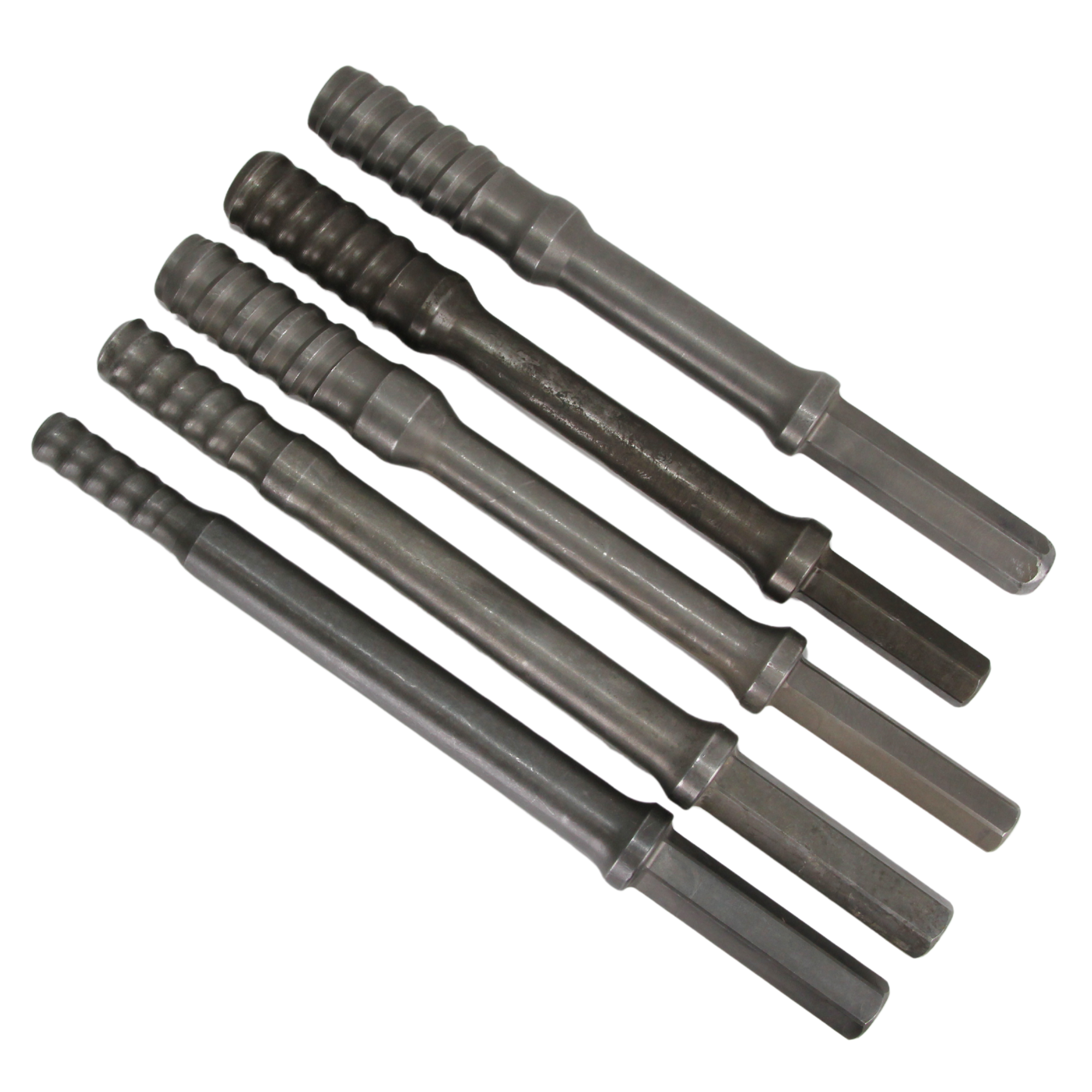
Hex Shanked Starter Rod
Best for: the everyday hole – one steel, many bits. Pick thread, shank size, and length.
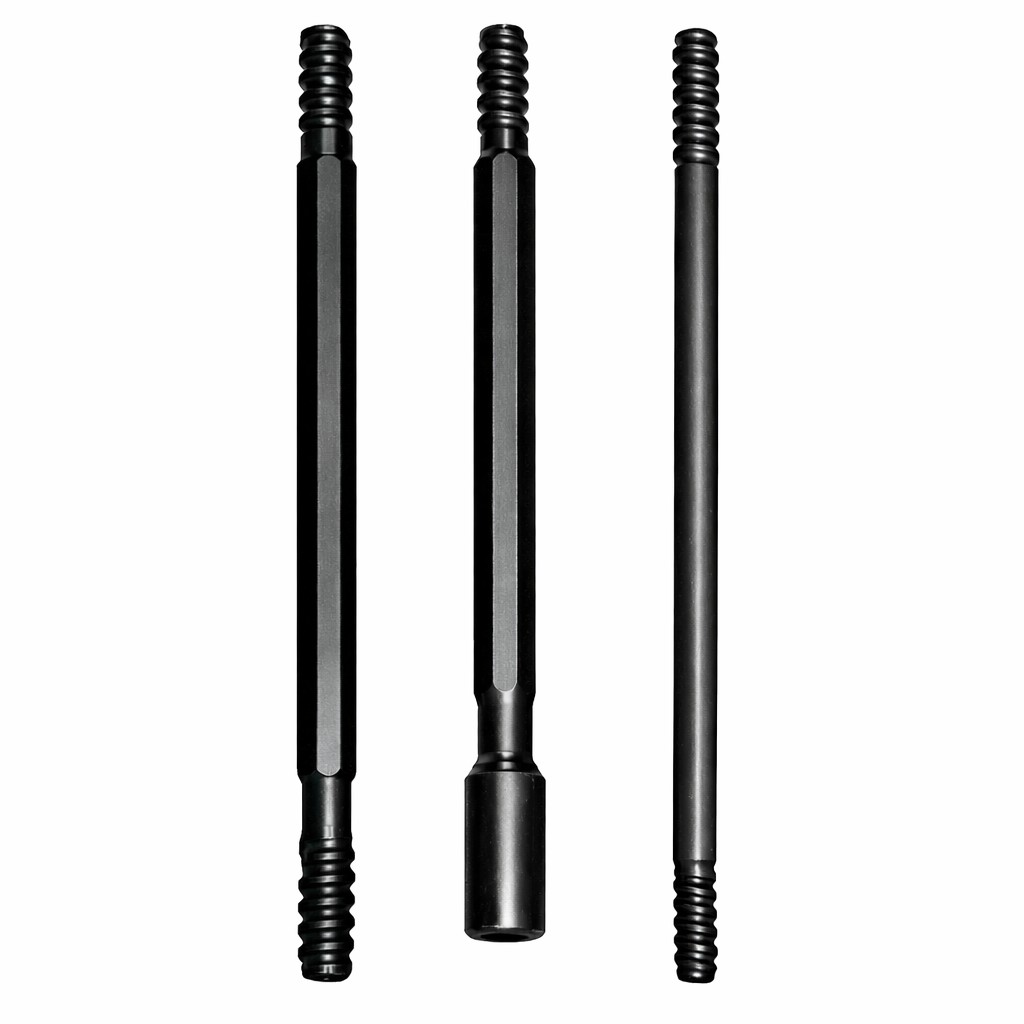
Top Hammer Extension Rod (Male/Male and Male/Female)
Best for: holes deeper than one steel – rods that join with couplings as the hole deepens.
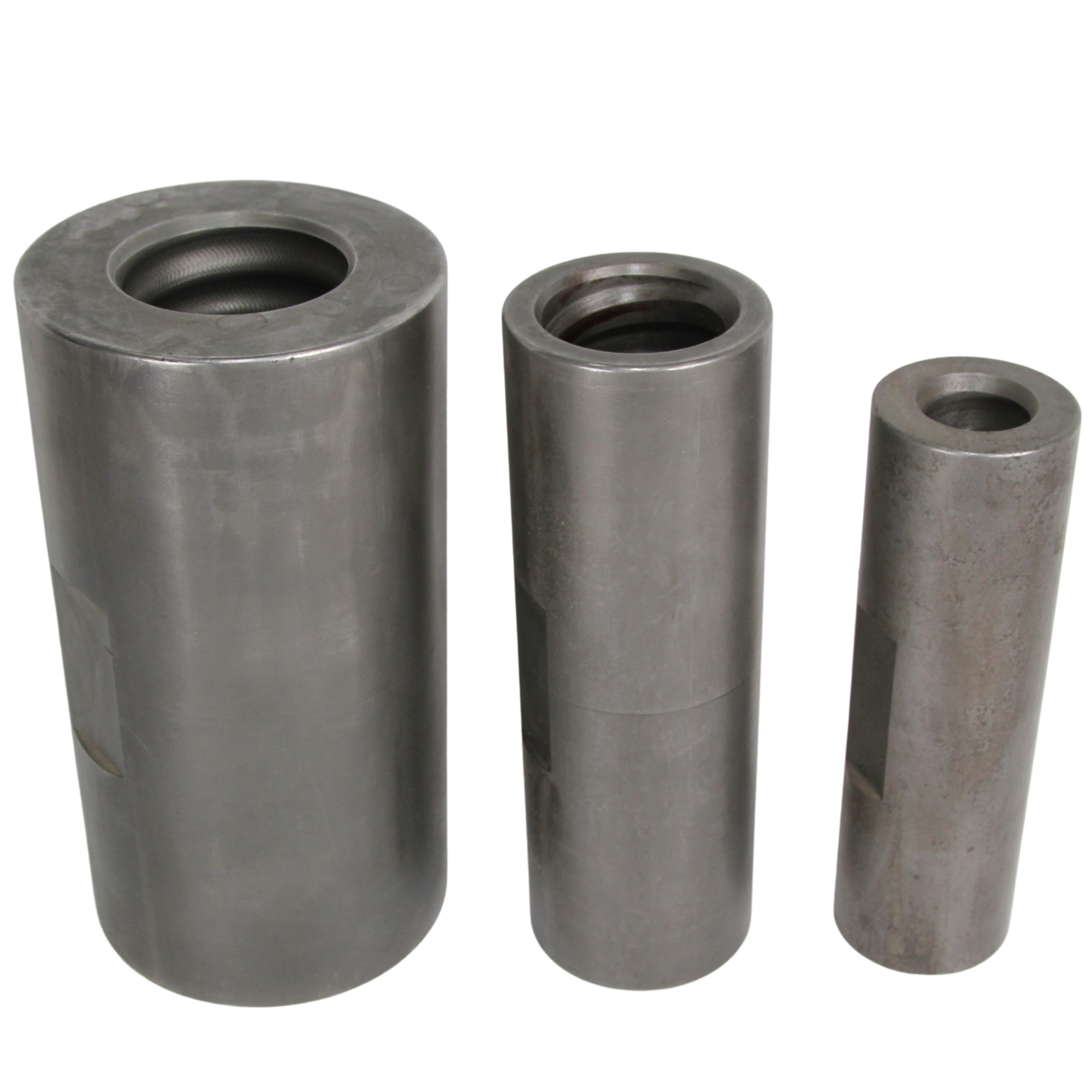
Coupling Adapter (Female to Female)
Best for: joining two different threads – the connective tissue for any mixed jobsite.
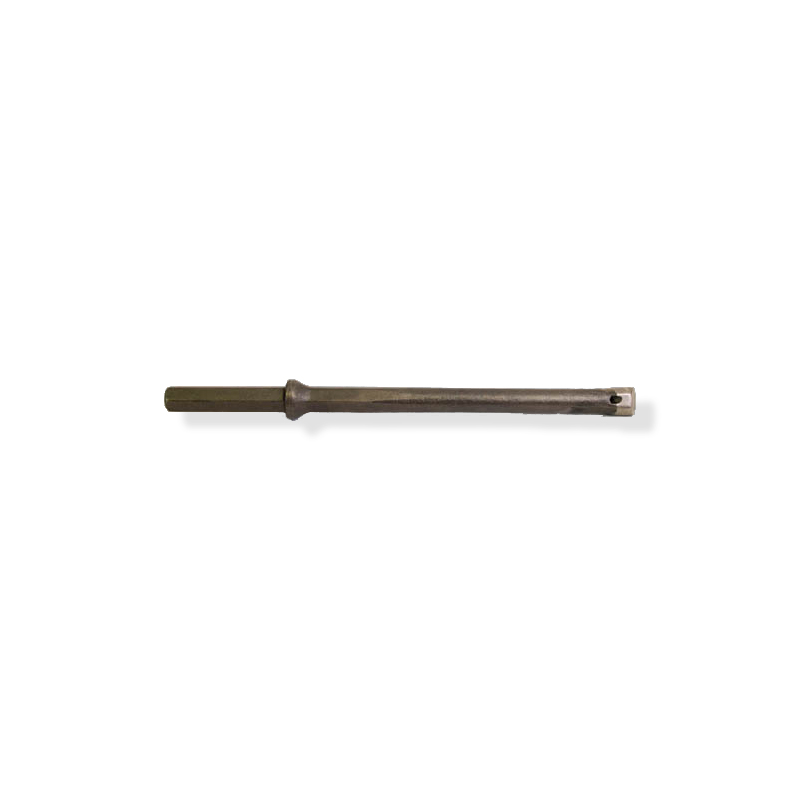
Whirlibit
Best for: shallow dowel and anchor holes – bit and steel in one forging, nothing to assemble.
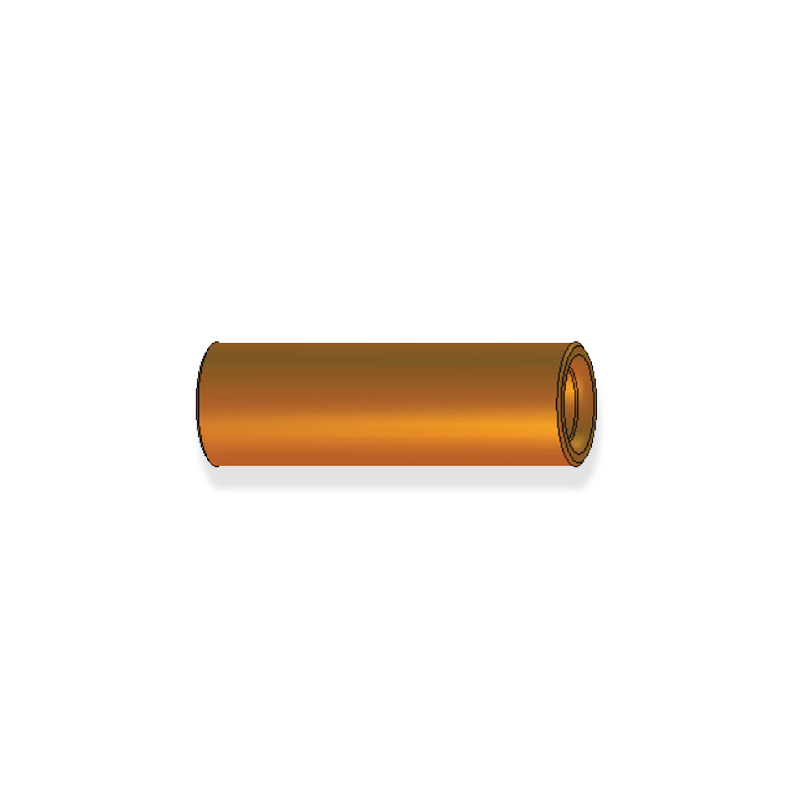
Threaded Coupling (Female to Female Thread)
Best for: joining two rods of the same thread on an extension string.
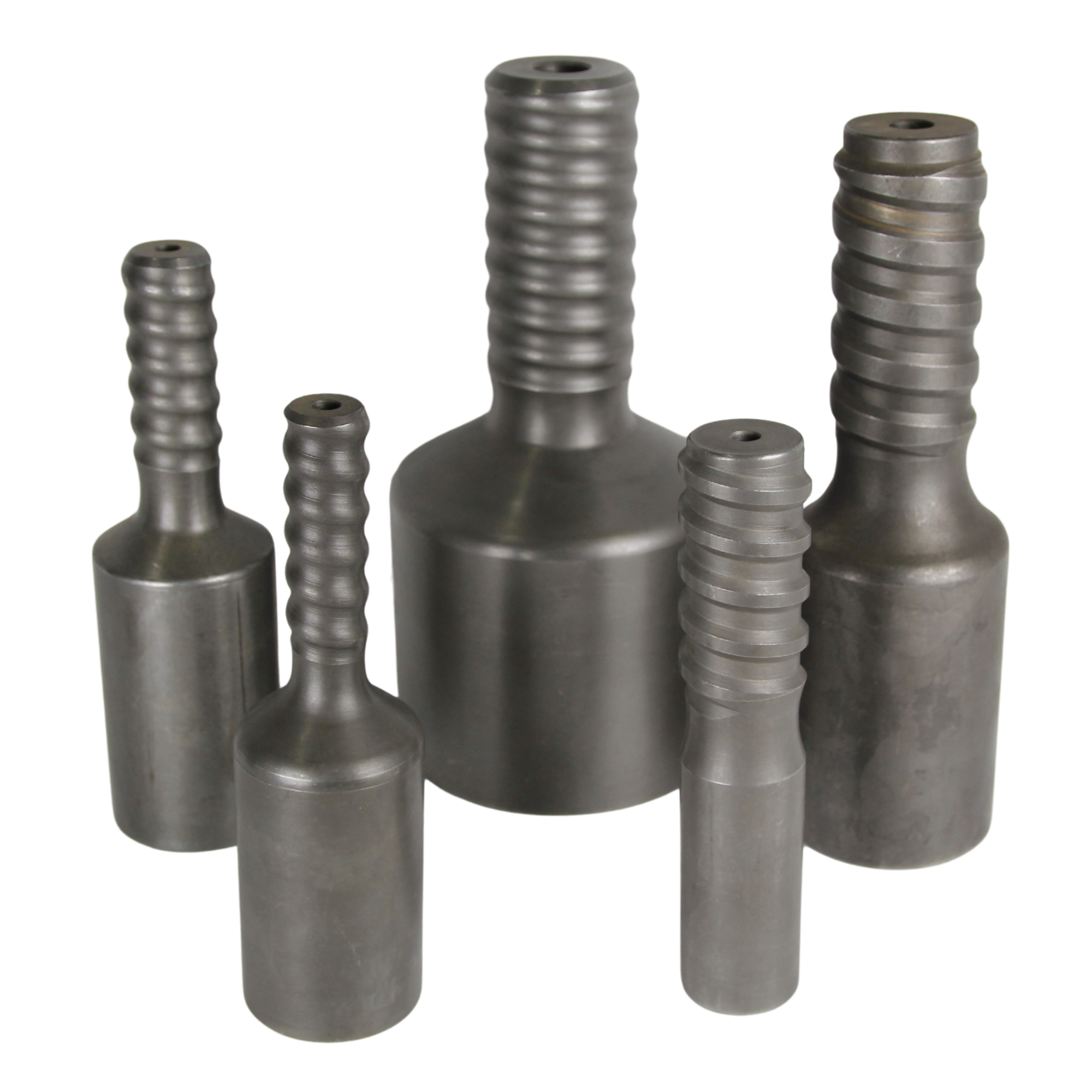
Bit Adapter (Male to Female Thread)
Best for: running one thread family’s bit on another family’s rod.
More steel, rods, and connectors in stock
Two Consumables That Pay for Themselves
Dry threads gall; dry shanks mushroom. Both are preventable. Thread compound on every make-up is credited with roughly 30% more rod life, and true rock drill oil at the chuck keeps the shank coming out wet.
Rock drill oil
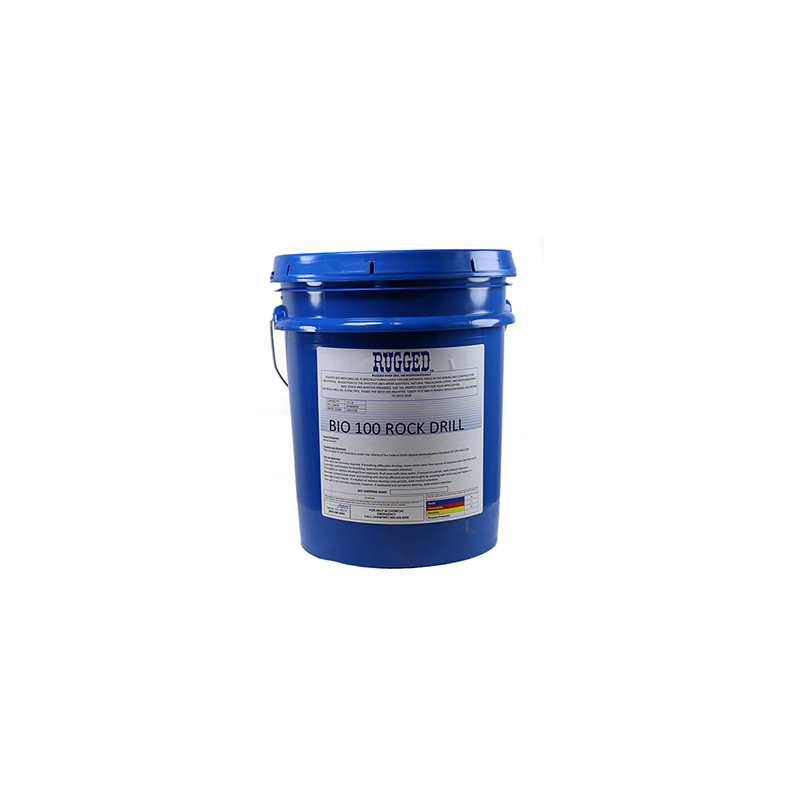
EP additives and tackifiers built for shock loading. ISO 32 for winter up to ISO 100-220 for hot weather and heavy tools – run it through a line oiler within 8 ft of the drill.
Pneumatic Tool and Rock Drill Oil – pick grade and size
from $42
Thread compound
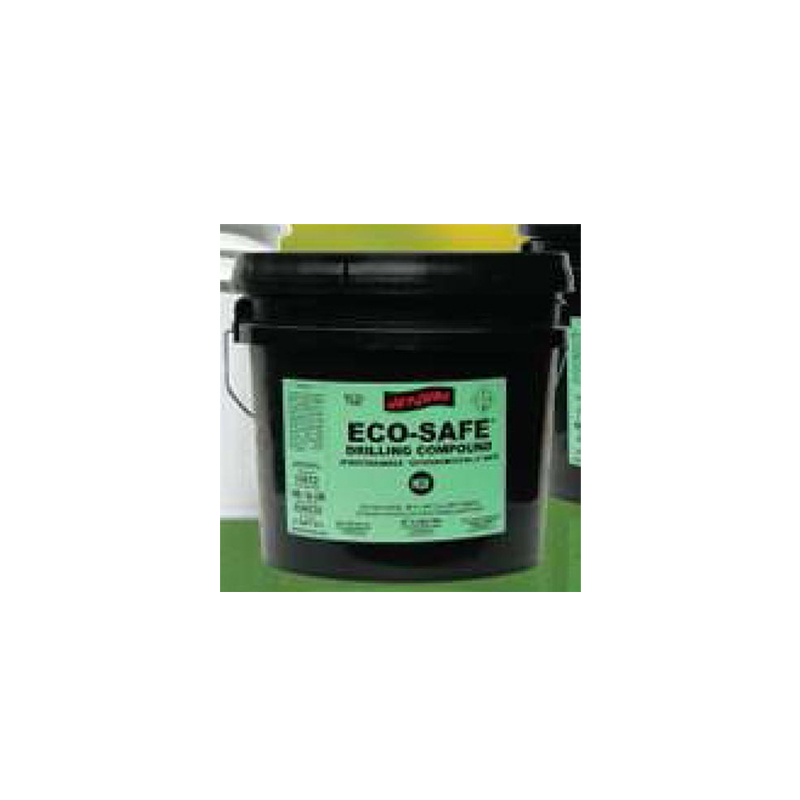
Non-metallic thread compound – grease the male thread before every make-up, not once a shift. Keeps joints tight enough to pass the wave, loose enough to break by hand.
Eco-Safe Non-Metallic Thread Compound, 2 gal
$267
Storage and Care That Prevent Breakage
Grease and inspect every shift
Grease every make-up; inspect threads at shift start and end. Never mix a worn component with a new one – a worn coupling eats a new rod’s threads in days.
Rotate rods in service
Move rods through positions so wear spreads across the set instead of concentrating in the string’s hottest joint.
Store dry, off the ground
On racks, thread protectors on. Corrosion pits become fatigue cracks; a rod left wet in a hole over a weekend is measurably closer to breaking.
Roll-check straightness
More than about 1/16 in of bow over 10 ft is scrap – as is anything with knife-edged threads or blue/purple heat discoloration.
Every Thread, Plus the Adapters to Cross Them
Drill Steel Questions, Answered Straight
How do I know which shank my drill takes?
What is the difference between H, rope, and T threads?
When do I need extension rods instead of one steel?
Can I connect two different threads?
What is a whirlibit, and when should I use one?
How much does thread lubrication really matter?
Build the Whole String in One Order
Shank to bit, with the couplings and adapters to cross any thread – and a driller on the phone who will identify what you have.
Configure your steelCall 1-888-883-5144