
Chicago Pneumatic Vane Air Motors
Seven vane air motor families for OEM machine integration — M16 through M180 and the heavy 2H410, in clockwise or reversible rotation, keyed or threaded output shafts, with ATEX-rated and stainless steel versions for chemical, food, and process plants. An air motor stalls indefinitely without damage, restarts under full load, and cannot spark.
The short version
Machine builders pick air motors on four axes: frame size (torque and power), free-speed range, rotation (clockwise or reversible), and shaft (keyed or threaded). The M-series table below maps the range; most frames carry dozens of buildable versions, so the product pages carry the full spec matrices. Corrosive washdown or food contact → the stainless steel motor. Mounting flanges and gearing are in air motor accessories; the full category is here. Application engineering → 1-888-883-5144.
M-Series & 2H410 Vane Air Motors
Six frame sizes from the compact M16 to the heavy 2H410, plus a stainless steel motor for corrosive and hygienic environments.
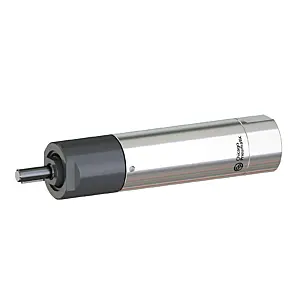
The frame ladder
Every frame is a family: the M25 alone builds 29 buyable versions across speed, rotation, and shaft options. Use the tiles for from-pricing and the product pages for full spec matrices — or call and we will configure the motor against your torque-speed point directly with CP.
Vane Air Motor · Compact
490-19,500 rpm options
The compact frame for small feeds, mixers, and spindle drives.
Free speed / Rotation
Vane Air Motor · Small Frame
100-21,500 rpm · 29 versions
The most-configured frame — clockwise or reversible, ATEX options.
29 configurations
Spec it on the product page — 29 buildable versions.
Vane Air Motor · Mid Frame
70-19,000 rpm · 24 versions
Mid-torque frame for conveyor, hoist, and agitator drives.
24 configurations
Spec it on the product page — 24 buildable versions.
Vane Air Motor · Large Frame
35-20,000 rpm · 31 versions
Higher-output frame for heavier continuous machine drives.
31 configurations
Spec it on the product page — 31 buildable versions.
Vane Air Motor · Heavy Frame
120-950 rpm · geared outputs
Low-speed geared torque for winches, mixers, and heavy feeds.
Free speed / Rotation
Vane Air Motor · Maximum
60-500 rpm · heavy output
The biggest motor in the line for the heaviest machine duty.
Free speed
Vane Air Motor · Stainless Steel
0.21-0.51 hp · 450-19,500 rpm
316-grade housings for washdown, chemical, and food environments.
20 configurations
Spec it on the product page — 20 buildable versions.
Which Frame Does Your Machine Need?
| Frame | Free-Speed Options | Rotation | Typical Duty |
|---|---|---|---|
| M16 | 490 – 19,500 rpm | Clockwise or reversible | Small feeds, spindles, lab agitators |
| M25 | 100 – 21,500 rpm | Clockwise or reversible · ATEX options | Mixers, pumps, tension drives |
| M39 | 70 – 19,000 rpm | Coaxial back-head options | Conveyors, hoists, agitators |
| M84 | 35 – 20,000 rpm | Keyed or threaded shaft | Heavy continuous machine drives |
| M180 | 120 – 950 rpm | Clockwise or reversible | Winches, heavy mixers, geared feeds |
| 2H410 | 60 – 500 rpm | Clockwise | Maximum-torque machine duty |
| Stainless | 450 – 19,500 rpm | Clockwise | Washdown, chemical, food contact |
Scroll the table sideways on a phone.
Vane Air Motors — Common Questions
Why use an air motor instead of an electric motor?
Four properties electric struggles to match: an air motor stalls indefinitely at full torque without damage and restarts by itself; its output adjusts smoothly with pressure and flow; it cannot spark, making classified areas straightforward; and it shrugs off heat, vibration, and washdown that kill windings. The trade is efficiency — compressed air is expensive energy — so air motors win on duty and environment, not on energy cost.
What does ATEX-rated mean for an air motor?
Certification for use in explosive atmospheres — gas, vapor, and dust zones in chemical plants, refineries, grain handling, and paint operations. The vane motor itself is inherently non-sparking; the ATEX version documents it with the marking and paperwork your compliance process needs. Several M25 versions carry the rating, and other frames can be quoted ATEX through CP.
How do I size an air motor for my application?
Start from the working point: the torque you need at the speed you need it. A vane motor makes maximum power at roughly half its free speed, and torque rises as it slows — so pick a frame whose curve puts your working point in the middle, not at the edge. Send us torque, speed, air pressure available, and the environment, and we will run it against the CP curves: 1-888-883-5144.
Keyed or threaded output shaft?
Keyed shafts take standard couplings, sprockets, and pulleys — the general-purpose choice for machine builds. Threaded shafts mount abrasives and specialized tooling directly on the spindle. Most frames sell both at the same price; it is purely about what you bolt on. Mounting flanges and gear options are in air motor accessories.
Why is the stainless steel motor different?
The housing and wetted surfaces are stainless, built for washdown chemicals, corrosive atmospheres, and food-adjacent duty where a painted or plated housing eventually sheds. Output range matches the compact frames (0.21-0.51 hp). If the environment is the problem rather than the load, this is the motor.
Building a Machine Around an Air Motor?
Send us the torque, speed, and environment and we will spec the frame, ratio, and shaft with CP application engineering.