
Chicago Pneumatic Rivet Busters
Three long-stroke air hammers built to shear structural rivets and heavy steel, $1,362 to $1,447. Cylinder strokes of 6, 8 and 11 in., D handle or pistol grip, on a common .890 x 1.125 in. taper shank.
The short version
The whole design brief of a rivet buster is energy per blow, not speed. A chipping hammer runs a 2 to 4 in. stroke at 1,500 to 2,600 blows a minute. A rivet buster runs a 6 to 11 in. stroke at 720 to 1,100 blows a minute. The long piston travel is what shears a rivet head clean instead of peening it flat. Pick on stroke: the CP 4611 at 11 in. and 720 BPM hits hardest and is the bridge and heavy structural tool; the CP 4608 at 8 in. is the general-purpose middle; the CP 4160 at 6 in. and 24 lb is the one to run overhead or all shift. All three take the same working steel.
What Is a Rivet Buster?
A rivet buster is a hand-held pneumatic hammer with an unusually long cylinder stroke, built for one job: driving a chisel through the head of a structural rivet so the rivet can be knocked out and the connection taken apart. It is the tool that dismantles riveted bridges, ships, boilers, tanks, penstocks and pre-1960 steel-framed buildings.
Mechanically it sits between a chipping hammer and a paving breaker. It uses a chipping-hammer style handle and trigger, but the piston travels 6 to 11 in. instead of 2 to 4, so each blow carries far more energy and the tool cycles far more slowly. That long, heavy blow is what shears hardened rivet steel rather than mushrooming it.
The same characteristic makes rivet busters useful well beyond rivets. Crews use them for cutting and splitting heavy plate, breaking out concrete around embedded steel, trimming reinforced sections, and any demolition where a chipping hammer is too light and a 60 lb breaker is too clumsy or cannot be swung into position.
Rivet buster vs chipping hammer
Same family, different stroke. A CP 4123 chipping hammer runs a 2 to 4 in. stroke at up to 2,400 blows a minute and weighs 13 to 16 lb. A CP 4611 rivet buster runs an 11 in. stroke at 720 blows a minute and weighs 33 lb. Use the chipping hammer for surface work and cleanup; use the buster when you need to cut through something.
Rivet buster vs paving breaker
A paving breaker is a downward tool that works under its own weight, with a 30 to 90 lb body and a 6 in. shank. A rivet buster is 24 to 34 lb, holds a much smaller taper shank, and is designed to be aimed horizontally and overhead at steel rather than dropped onto slab.
Why the trigger position matters
Every model here comes as a D handle with an inside trigger or a pistol grip with an outside trigger, at the same price. The D handle gives two-handed control for sustained cutting; the pistol grip is easier to work into tight steelwork and overhead. This is an operator preference, not a performance difference.
The CP Rivet Buster Line
Three tools, one shank. The .890 x 1.125 in. taper is common across the CP 4608 and CP 4611, so a rack of cutters, points and backout punches serves the whole line. Pick a handle style below and add it to the cart.
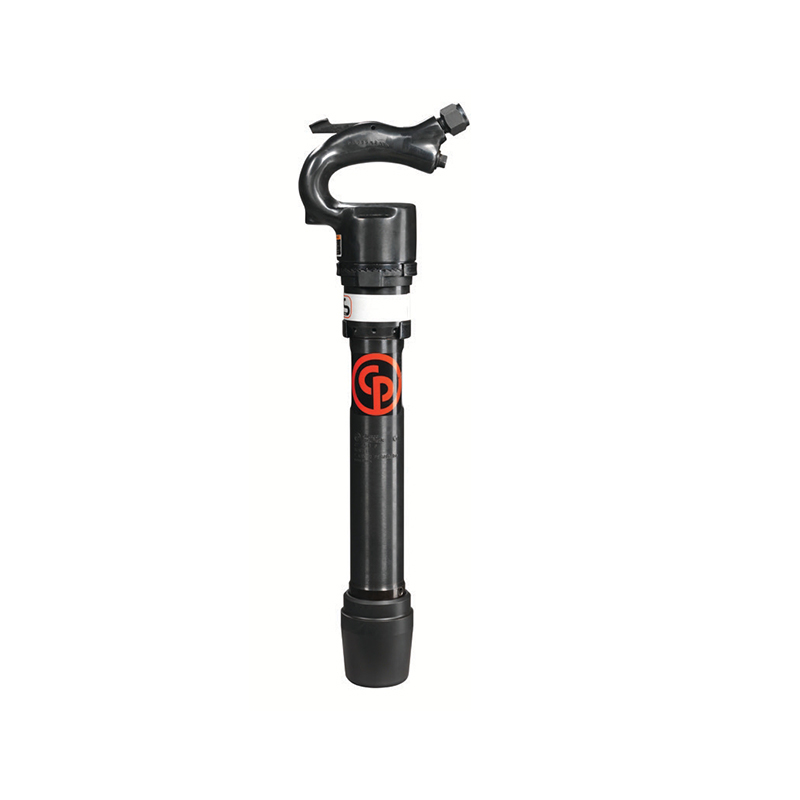
CP 4611 Pneumatic Rivet Buster
The long-cylinder buster and the heaviest hitter of the three. An 11 in. stroke at 720 blows a minute puts far more energy into each blow than the faster tools, which is what shears a heavy structural rivet rather than peening it over.
45 CFM · 720 BPM · 11 in. cylinder stroke · 33 to 34 lb · 26 in. long · 1/2 in. air inlet · .890 x 1.125 in. taper shank
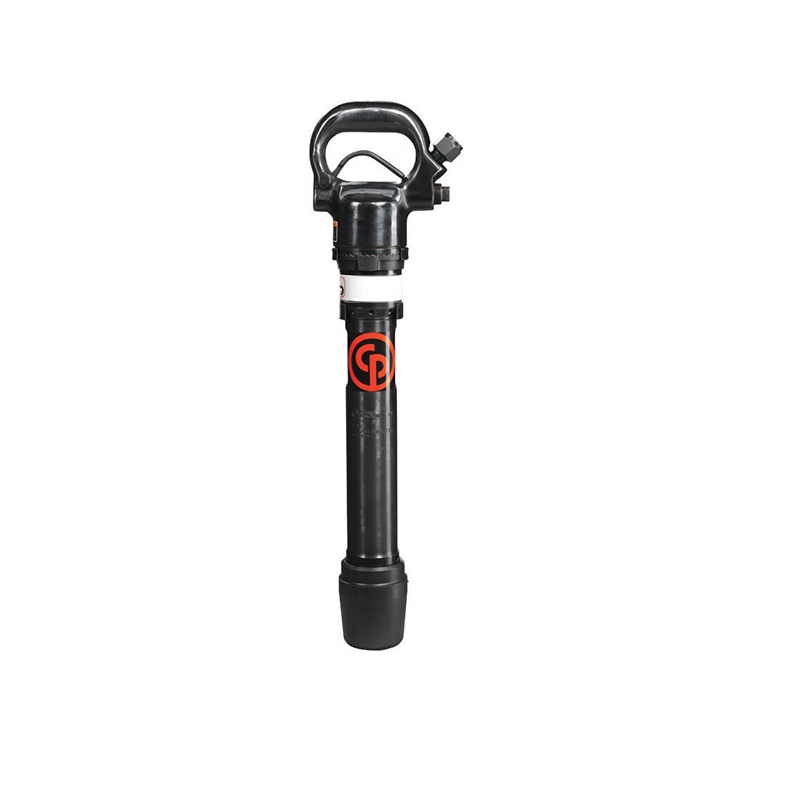
CP 4608 Pneumatic Rivet Buster
The middle buster: an 8 in. stroke at 1,080 blows a minute, 30 to 31 lb and 23 in. long. Faster cycling than the 4611 and lighter in the hand, at the cost of energy per blow. The same .890 x 1.125 in. taper shank as the 4611.
45 CFM · 1,080 BPM · 8 in. cylinder stroke · 30 to 31 lb · 23 in. long · 1/2 in. air inlet · .890 x 1.125 in. taper shank
CP 4160 Pneumatic Rivet Buster
The light, fast buster: a 6 in. stroke at 1,100 blows a minute on 44 CFM, 24 to 25 lb and 20.5 in. long. The one to pick for overhead work and for jobs where you are running the tool most of the shift rather than shearing heavy plate.
44 CFM · 1,100 BPM · 6 in. cylinder stroke · 24 to 25 lb · 20.5 in. long · 1/2 in. air inlet · jumbo shank
Compare All Three Busters
Factory figures from the Chicago Pneumatic rivet buster datasheet. Both handle styles of each model carry the same specification and the same price.
| Model | Cylinder stroke | Blows/min | Air | Weight | Length | Air inlet | Shank | Price |
|---|---|---|---|---|---|---|---|---|
| CP 4160 | 6 in. | 1,100 | 44 CFM | 24 to 25 lb | 20.5 in. | 1/2 in. | Jumbo | $1,428 |
| CP 4608 | 8 in. | 1,080 | 45 CFM | 30 to 31 lb | 23 in. | 1/2 in. | .890 x 1.125 in. taper | $1,362 |
| CP 4611 | 11 in. | 720 | 45 CFM | 33 to 34 lb | 26 in. | 1/2 in. | .890 x 1.125 in. taper | $1,447 |
Swipe the table sideways to see every column.
Note that the price does not track the size. The 8 in. CP 4608 is the cheapest of the three at $1,362, the 6 in. CP 4160 is $1,428 and the 11 in. CP 4611 is $1,447. Only about $85 separates the lightest tool from the heaviest hitter, so choose on the work rather than on the ticket.
Air draw is effectively flat across the line at 44 to 45 CFM. Whichever buster you pick, a CPS 110 at 95 CFM will run it with room for a second tool, and a CPS 185 will run three.
Working Steel
Rivet buster steel is ordered by working end. Chicago Pneumatic catalogue the following types for this line, each in several overall lengths.
| Working end | What it does |
|---|---|
| Moil point | General breaking and starting. The point concentrates the blow, and it is what you reach for on concrete around embedded steel. |
| Narrow chisel | Cutting and splitting. The standard first choice for plate work and for opening a line. |
| Loose rivet cutter | For rivets that already have some play in them. Shears the head with less risk of the cutter walking off the crown. |
| Tight rivet cutter | For rivets still seated hard. A different edge geometry that bites a tight head instead of skating across it. |
| Rivet buster | The dedicated head-removal profile, sized to the rivet crown. |
| Ripper | Tearing and peeling work on plate and sheet, rather than point cutting. |
| Backout punch | Drives the shank of the rivet out of the hole once the head is off. Ordered in a range of diameters to match the hole. |
| Drift pin driver | Part 3083 4143 00. 7/8 in. diameter, 7-1/2 in. overall, 1-1/2 lb. Drives drift pins for aligning holes in steel connections. |
Swipe the table sideways to see every column.
We have deliberately not published a length-by-length part number table here. The lengths, tip widths and ordering numbers in the factory steel table did not come through our source copy cleanly enough for us to stand behind them in print, and a wrong part number on a working steel wastes your time and ours. Call 1-888-883-5144 with the buster model and the length you want and we will confirm the ordering number against the current Chicago Pneumatic accessories list before anything ships.
Consumables, Hoses and Air Line
Chicago Pneumatic are explicit about this: water separators and lubricators improve the performance of these hammers and extend their life by reducing premature wear. On a $1,400 tool that runs in concrete dust, it is the cheapest insurance available.
Recommended with every buster
| Item | Part no. | Fits |
|---|---|---|
| Rubber bumper | 3303 0051 03 | CP 4608 and CP 4611 only |
| Polyurethane bumper | 9753 2180 82 | All |
| Upper sleeve | P 156988 | CP 4608 and CP 4611 only |
| Lower sleeve | P 072333 | CP 4608 and CP 4611 only |
| Retainer spring, standard | P 073942 | All |
| Whip hose, 1/2 in. pipe swivel with 10 ft rubber hose | 9246 0203 64 | All |
Swipe the table sideways to see every column.
Air line and lubrication
| Item | Part no. |
|---|---|
| CP water separator, 3/4 in. NPT thread | 8900 0050 01 |
| Air swivel, 1/2 in. NPT | 9246 0203 72 |
| Red X hose | 8900 0050 08 |
| Whip hose with 3.7 oz oiler, 1/2 in. swivel and 6 ft rubber hose | 9246 0206 04 |
| Whip hose with 5 oz oiler, 1/2 in. swivel and 10 ft rubber hose | 9246 0203 61 |
| Lubricator, 3/4 in. NPT, 5 oz | 9246 0203 69 |
| Lubricator, 3/4 in. NPT, 8 oz | 9246 0206 64 |
| Lubricator, 3/4 in. NPT, 11 oz | 9246 0203 68 |
| CP Airolene Plus tool oil, 1 gallon | 8099 0202 49 |
| CP Airolene Plus tool oil, case of four 1 gallon | 8099 0202 51 |
Swipe the table sideways to see every column.
The order that matters: compressor, then water separator, then lubricator, then whip hose, then tool. Putting the lubricator ahead of the separator just washes the oil straight back out of the line.
Chicago Pneumatic Rivet Buster FAQ
What is a rivet buster used for?
A rivet buster is a long-stroke pneumatic hammer used to shear the heads off structural rivets so a riveted connection can be dismantled. It is the standard tool for taking apart riveted bridges, ships, boilers, tanks and older steel-framed buildings. Because of its long stroke and high energy per blow it is also widely used for cutting and splitting heavy plate, breaking concrete around embedded steel, and demolition work where a chipping hammer is too light.
What is the difference between a rivet buster and a chipping hammer?
Stroke length and energy per blow. A CP 4123 chipping hammer runs a 2 to 4 in. cylinder stroke at 1,500 to 2,400 blows a minute and weighs 13 to 16 lb. A CP 4611 rivet buster runs an 11 in. stroke at 720 blows a minute and weighs 33 lb. The chipping hammer is for surface work, scaling and cleanup; the rivet buster is for cutting through material.
Which CP rivet buster should I buy?
Pick on cylinder stroke. The CP 4611 at 11 in. and 720 BPM puts the most energy into each blow and is the tool for heavy structural rivets and bridge work. The CP 4608 at 8 in. and 1,080 BPM is the general-purpose middle choice, lighter in the hand at 30 lb and the cheapest of the three. The CP 4160 at 6 in., 1,100 BPM and 24 lb is the one to pick for overhead work and for jobs where the tool runs most of the shift.
D handle or pistol grip?
Both styles cost the same and share the same internals, so it is purely about how you work. The D handle puts the trigger inside the handle and gives two-handed control for sustained cutting. The pistol grip puts the trigger outside and is easier to work into tight steelwork and overhead positions.
What size compressor do I need for a rivet buster?
All three models draw 44 to 45 CFM at 90 psi, so a CPS 110 at 95 CFM will run any of them with enough left over for a second hand tool. A CPS 185 at 180 CFM will run three busters at once. Keep the hose diameter up and the run short; pressure lost in the line is energy the tool never delivers.
What working steel do these take?
Chicago Pneumatic list moil points, narrow chisels, loose and tight rivet cutters, rivet buster profiles, rippers, backout punches and drift pin drivers for this line, each in several lengths. The CP 4608 and CP 4611 share a .890 x 1.125 in. taper shank, so steel moves between them. Call 1-888-883-5144 with your model and the length you want and we will confirm the ordering number before it ships.
What consumables should I order with the tool?
Chicago Pneumatic recommend buying the rubber bumper (3303 0051 03), lower sleeve (P 072333), upper sleeve (P 156988), retainer spring (P 073942) and a whip hose (9246 0203 64) alongside every buster. Add a water separator (8900 0050 01) and an in-line lubricator, because water and grit in the air line are what wear these tools out.
Do you stock CP rivet busters?
Yes. All three models in both handle styles ship the same day on orders placed by 4 PM Eastern. Add a configuration to the cart above, or call 1-888-883-5144 for multiples and freight.
Rivet busters in stock and ready to ship
Tell us the job and we will tell you the stroke. Same day shipping on all three models, and we will put the consumable kit together with the tool.