
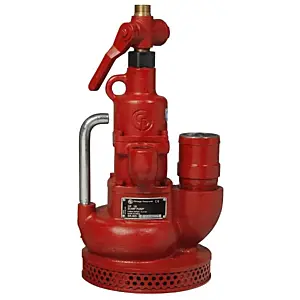
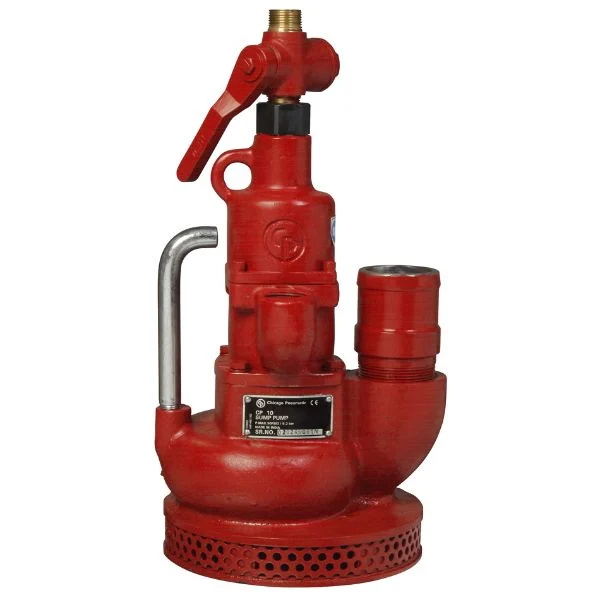
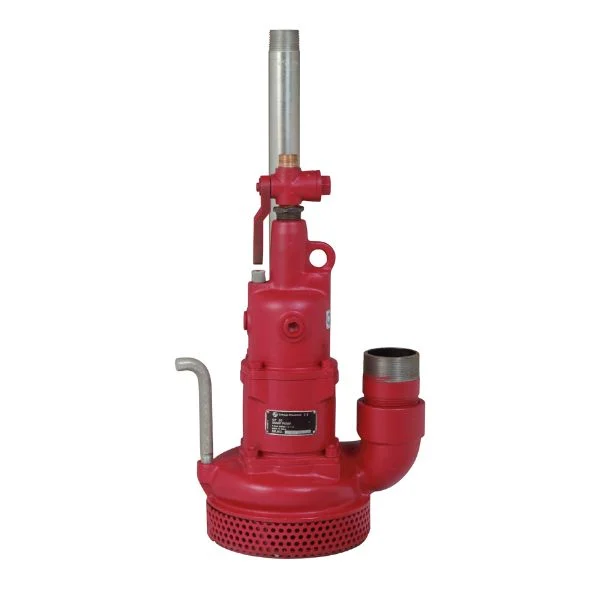
Chicago Pneumatic CP 0010 and CP 0020 are air-powered submersible sump pumps for dewatering trenches, ditches, manholes, industrial sumps and excavations where electric pumps are impractical or unsafe. Each runs off jobsite compressed air with no motor windings, cords or fuel, so there is no spark risk and nothing to burn out if the pump runs dry. Pick the motor size from the dropdown: the 3 hp CP 0010 discharges through a 2 in. NPT outlet, the 4 hp CP 0020 through 2-1/2 in. NPT, and both draw water down to within 7/8 in. of the base for near-dry cleanup.
- Compressed-air drive: 100 CFM at 90 psi for the 3 hp CP 0010, 110 CFM at 90 psi for the 4 hp CP 0020; runs from a standard portable compressor
- Cast-iron construction built for trench water, mud and abrasive fines on demolition, utility and mining sites
- CP 0010 (3 hp): 2 in. NPT discharge, 100 ft max head, 33 lb, fits through an 8-1/4 x 9 in. opening, 17-1/2 in. tall
- CP 0020 (4 hp): 2-1/2 in. NPT discharge, 90 ft max head, 58 lb, fits through a 9 x 11-3/4 in. opening, 16 in. tall
- Pumps down to a 7/8 in. minimum water depth in confined or low-level areas
- Muffled exhaust; no electrical components to fail in wet or spark-sensitive locations
- Stocked by Crowder Supply, an authorized Chicago Pneumatic dealer, with free UPS Ground and Same Day Shipping on in-stock orders by 4 PM Eastern
Which model do I need?
Choose the 3 hp CP 0010 for general trench and manhole dewatering where a 2 in. discharge hose is already on site and the pump has to fit a tight opening. Step up to the 4 hp CP 0020 when you need more volume through a 2-1/2 in. hose and have the air to feed the larger motor. For liquids carrying rock fragments, drill cuttings or heavy sludge, or for pumping from above the liquid, see the Chicago Pneumatic CP 0077 pneumatic sludge pump instead.
Air supply
The CP 0010 connects to a 3/4 in. NPT air inlet and runs on 3/4 in. air hose; the CP 0020 uses a 1 in. NPT inlet and 1 in. hose. Pump curves are rated at 87 psi; lower supply pressure reduces flow and head, and liquids thicker than water will not match the published curve.