
Chicago Pneumatic Engraving Pens & Air Scribes
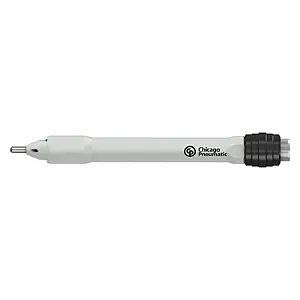
Two pneumatic engraving tools for permanent part marking: the CP9161 pen at 11,400 blows per minute, and the CP9361 air scribe at 13,500 BPM with a 1/8 in. hex stylus — VIN and serial marking, weld-map layout, and toolroom identification on steel, alloys, and glass.
The short version
A pneumatic engraver is a percussive stylus, not a rotary cutter: a carbide point vibrating thousands of times a second walks across the surface and leaves a permanent mark in any metal softer than the point. The CP9161 is the compact marking pen; the CP9361 adds power and a kit version with hose, stylus, chisels, and case. Marking depth follows air pressure, so a regulated drop gives repeatable marks. Both live in percussive tools; spare styluses come through the parts lookup. Questions: 1-888-883-5144.
CP9161 & CP9361 Pneumatic Engravers
11,400-13,500 blows per minute through a carbide stylus — the marking tools of toolrooms, fab shops, and inspection benches.
Permanent marks, hand-guided
The CP9161 writes like a heavy pen — serials, asset numbers, and inspection stamps on anything from hand tools to molds. The CP9361 steps up blow energy for deeper marks and doubles as a fine chisel for detail cleanup; its kit version packs hose, stylus, chisels, and case for a complete marking station.
Engraving Pen
11,400 BPM · pen grip
Serial, VIN, and asset marking with pen-like control.
Impact rate
Air Scribe · 1/8 in. Hex
13,500 BPM · 1/8 in. hex stylus
Deeper marks and fine chiselling; kit adds hose, chisels, and case.
Configuration
Engraving Pens & Air Scribes — Common Questions
What is a pneumatic engraving pen used for?
Permanent identification: VIN and serial numbers, asset tags on tools and fixtures, weld maps and layout lines, inspection stamps, and mold or die marking. The carbide stylus displaces metal rather than cutting it, so the mark survives paint, corrosion, and years of handling — which is the point.
Will it mark hardened steel?
Anything meaningfully softer than the carbide point marks cleanly — mild and alloy steel, stainless, aluminum, brass, cast iron, and glass. Fully hardened tool steel at the top of the scale marks shallow and wears points faster; for volume marking of hardened parts, consider dot-peen machines and keep the air scribe for everything else.
How do I control marking depth?
Air pressure. Run the pen on a regulated drop and set depth with the regulator — lower pressure for jewelry-fine lines on thin material, full pressure for deep marks in structural steel. A consistent regulator setting is what makes production marks uniform; an FRL from accessories does it.
Engraving pen or rotary engraver?
A percussive pen marks faster, works on curved and rough surfaces, and never loads up with chips — but it draws a dotted-line stroke. A rotary engraver cuts a continuous groove for cosmetic work. For industrial identification the percussive pen wins on speed and durability of mark; for trophy plates, buy rotary. For heavier percussive work entirely, see the riveting tools.
Marking Parts in Production?
Tell us the material and the mark spec and we will pick the pen, the stylus, and the regulator setting. Stocked in Denver.