
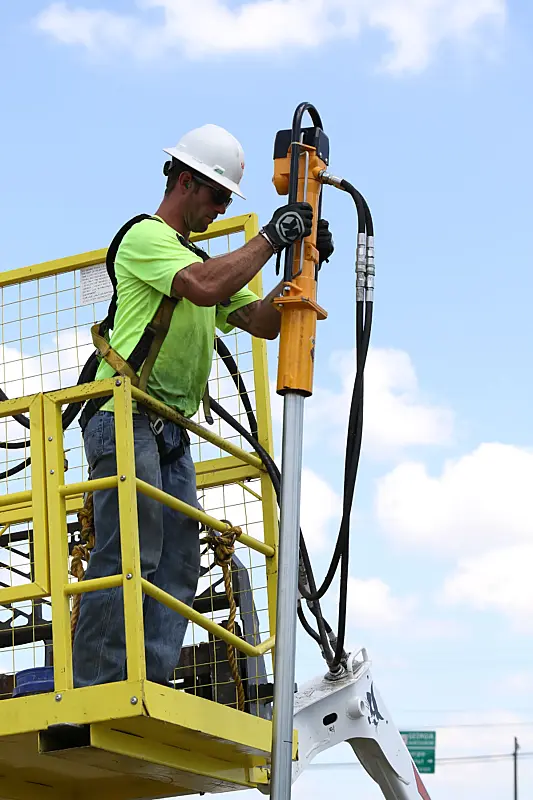
Rhino Hydraulic Post Drivers
One 64 lb tool, 1,380 blows a minute, powered by a Rhino pack or straight off the skid steer, tractor or mini excavator you already own. A closed hydraulic system that will not freeze, will not breathe dust, and puts no exhaust at the operator.
The short version
The HPD 60 needs 8 GPM at 1,725 psi. Get that from a Rhino HPP power pack (set the lever to 8 and you are done), or from a machine you already own — skid steer, tractor, mini excavator — with an oil flow divider in between. Skip the divider on a carrier and you will cook the tool.
The Rhino HPD 60 Hydraulic Post Driver
Fencing, road signs, farm and ranch, forestry, vineyards, guardrail, anchors and tent stakes — a heavy-duty driving tool that weighs less than the pneumatic machines it replaces.
Rhino HPD 60 Hydraulic Post Driver
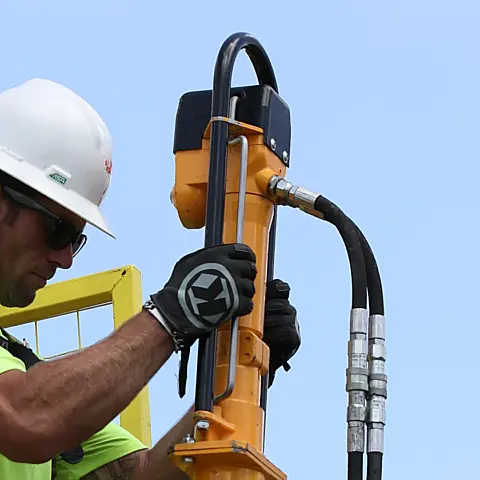
64 lb of tool delivering 95 joules a blow, 1,380 times a minute, off 8 GPM at 1,725 psi. A closed hydraulic system means no dust in, no exhaust at the tool, and no freezing in below-zero work. One-piece shuttle valve and a nitrogen accumulator rated seven times the life of a typical tool.
Two Ways to Power It
Every hydraulic tool needs oil at the right flow and the right pressure. You can buy that as a dedicated pack, or borrow it from a machine already on site.
1. A Rhino hydraulic power pack
Purpose-built, adjustable, and needs no flow divider — set the control lever to 8 GPM and the pack delivers exactly what the driver is rated for. Both packs will also run breakers, cut-off saws, diamond chainsaws, core drills and submersible pumps: anything wanting 5–10 GPM at 1,750–2,300 psi.
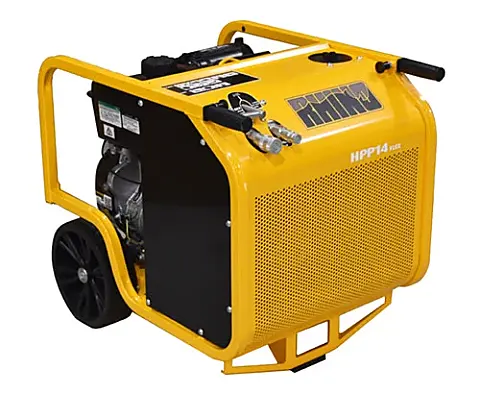
Rhino HPP 14 Flex
The lighter of the two packs and the usual pairing for a single HPD 60. Adjustable 5, 8 GPM control lever, direct pump-driven air-fan oil cooler, and 1,750 psi nominal – exactly what the driver wants, with nothing to divide down.
Rhino HPP 18V Flex
Three flow settings instead of two, a bigger tank, and electric start with recoil as backup so a dead battery never ends the day. Pick it if you also run breakers, cut-off saws, core drills or submersible pumps off the same pack.
2. Equipment you already own, plus an oil flow divider
A tractor, work truck, mini excavator, skid steer, telehandler or backhoe can all run the HPD 60. The catch is that almost none of them run it at 8 GPM.
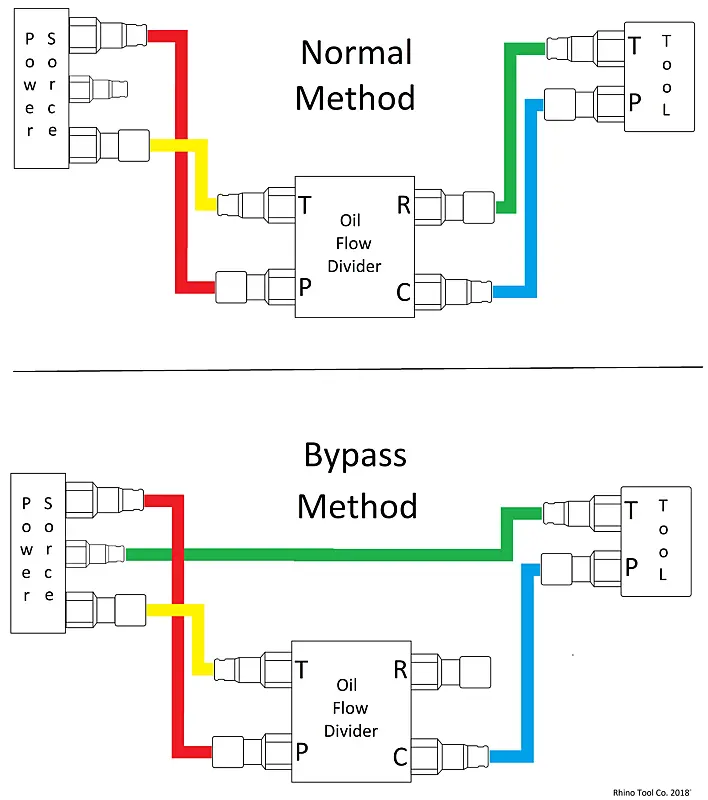
What the divider actually does
A flow divider takes everything your carrier sends, passes the tool the share it is rated for, and bypasses the rest straight back to tank. Without one, the surplus has nowhere to go but across a relief valve — as heat, into your oil and into the tool.
Rhino’s own instruction is blunt: never let the power source run with higher oil flow than necessary.
= about 8 hydraulic HP
Hydraulic horsepower is flow times pressure divided by 1,714. Run the numbers on your own machine and the gap is usually bigger than people expect — which is why the divider is not optional on a carrier.
Match your power source
Check the auxiliary circuit, not the main pump. Auxiliary flow is what actually reaches the attachment couplers and is often well below total pump output.
| Power source | Typical flow | Typical pressure | Flow divider needed? |
|---|---|---|---|
| Rhino HPP 14 Flex | 5-8 GPM | 1,750 psi | No – set the lever to 8 |
| Rhino HPP 18V Flex | 5-8-10 GPM | 1,750 psi | No – set the lever to 8 |
| Compact tractor rear remote | 8-15 GPM | 2,000-2,500 psi | Yes if above 8 GPM |
| Mini excavator, standard aux | 10-22 GPM | 2,500-3,300 psi | Yes |
| Skid steer, standard flow | 17-25 GPM | 3,000-3,500 psi | Yes |
| Skid steer, high flow | 26-45 GPM | 3,300-4,050 psi | Yes |
| Telehandler / backhoe aux | 15-30 GPM | 2,500-3,500 psi | Yes |
Swipe the table sideways to see every column.
Watch the return line too. The HPD 60 is rated for a maximum 220 psi return pressure. A restricted, undersized or shared return will damage the tool even when supply flow is set correctly. Run the return to its own port where you can, and keep couplings to a minimum — every pair adds restriction.
Oil flow dividers we stock
Rhino HFD Oil Flow Divider
Steps down to 8, 10 or 12 GPM. Rhino’s own divider, adjustable across the three settings the HPD 60 is rated for. 1/2 in. connections.
Hycon Oil Flow Divider
Steps down to 5, 8 or 10 GPM. Takes up to 22 GPM in and steps it down to 5, 8 or 10 GPM out. The lower-cost option if your carrier is a standard-flow machine.
Chucks, Adapters and Hose
The master chuck is required before any adapter. Adapters and drive caps from the pneumatic PD-55 also fit the HPD 60, as does the Chuck-Lok system from the gas drivers.
Drive caps for anchors are sold by the outside dimension of the anchor. See all stocked HPD hydraulic accessories.
Where Hydraulic Wins
Wet and freezing work
The closed system will not freeze in below-zero temperatures and is water resistant — the reason hydraulic gets picked for winter fence and marine work.
You already own the carrier
If there is a skid steer, tractor or mini excavator on site, a divider and a driver are far cheaper than adding a compressor.
Sign and guardrail crews
Channel post to 4 lb/ft and square tube break-away anchors, driven to within two inches of grade.
Chucks and adapters →Low maintenance
Fewer internal parts, continuous lubrication in a sealed system, and a nitrogen accumulator rated seven times the life of a typical tool.
Operator comfort
Vibration dampening, a one-piece handle and a built-in lift-assist point. No exhaust at the tool and markedly quieter than air.
Tall posts
Add the remote valve and run the trigger from the ground instead of climbing to reach the top of the post.
Remote valve →Need air or self-contained instead? See Rhino pneumatic post drivers and gas post drivers, the full post driver category, or post pullers.
See It Work
Rhino hydraulic tools · 0:51
Fifty seconds on what hydraulic changes
Watch the setup: two hoses and a coupler, and the tool is live. No compressor to warm up, no hose to run down the fence line, no engine on the tool to start.
Note how little the operator has to lean on it. At 95 joules a blow the tool does the driving, which is the whole argument for hydraulic on a long day.
Hydraulic Post Driver Questions
What is a hydraulic post driver?
A hydraulic post driver is a hand-held hammer run off hydraulic oil instead of compressed air or an engine. The Rhino HPD 60 takes 8 GPM at 1,725 psi and delivers 95 joules a blow, 1,380 times a minute. Because the system is closed, no dust gets in, there is no exhaust at the tool, and it will run in wet or below-freezing conditions that stop other tools.
Can I run it off my skid steer or tractor?
Yes – that is one of the main reasons to buy hydraulic. The HPD 60 will run off a tractor, work truck, mini excavator, skid steer, telehandler or backhoe. What you must add is an oil flow divider. A standard-flow skid steer puts out 17 to 25 GPM at 3,000 to 3,500 psi; the tool wants 8 GPM at 1,725. Without a divider you are sending roughly five times the hydraulic horsepower the tool was built for.
Do I need a flow divider with a Rhino power pack?
No. The HPP 14 Flex and HPP 18V Flex have an adjustable flow lever – set it to 8 GPM and the pack delivers exactly what the driver needs at 1,750 psi nominal. The divider only exists for the case where your power source is a machine built to run much larger attachments.
How do I know how much flow my machine puts out?
Check the auxiliary circuit spec, not the main pump. Auxiliary flow is what reaches the attachment couplers, and it is often far lower than the machine’s total pump output. It is on the data plate, in the operator manual, or from your dealer with the model and serial number. If you cannot find it, an inline flow meter tested with hot oil at full engine speed is the honest answer.
What happens if I run too much flow into the tool?
Heat and wear, then failure. Excess oil has to go somewhere, and it goes across a relief as heat. Rhino’s own guidance is blunt: never let the power source run with higher oil flow than necessary. Watch return-line pressure too – the HPD 60 is rated for a maximum 220 psi on return, so a restricted or undersized return line will damage it even when the supply flow is correct.
What size hose should I run?
The longer the run, the bigger the hose. Rhino publishes maximum hose length by diameter at 8 GPM and 2,175 psi for 3/8 in., 1/2 in. and 5/8 in. hose. Every pair of couplings adds restriction, so count them in. Extension hoses come in 20 ft and 30 ft; if you need more reach than that, step up the hose diameter rather than just adding length.
What posts will the HPD 60 drive?
T-post, ground rod, tent stake, square post, Schedule 40 pipe up to 3-7/8 in., and channel post up to 3-4 lb/ft. Largest chuck sizes are 3-3/4 in. round, 2-5/8 in. square and 3-1/4 in. hex. Adapters and drive caps from the pneumatic PD-55 also fit, as does the Chuck-Lok system from the gas drivers for 2-3/8 in. and smaller.
Can it drive break-away sign posts and guardrail?
Yes, with the right chuck. Rhino makes break-away anchor systems for both channel post and square tube that drive the anchor to within two inches of ground level – up to a 4 lb/ft channel anchor or a 2-1/2 in. square anchor. Each needs the master chuck plus a chuck adapter and a drive cap sized to the anchor’s outside dimension. Call us with the post spec and we will assemble the list.
Hydraulic, air or gas – which should I choose?
Hydraulic if you already own the carrier, if you work wet or cold, or if you want the least maintenance. Air if you already tow a compressor. Gas if you need to walk away from all support equipment. The hydraulic tool is the quietest of the three at the operator and the only one that will not freeze up in sub-zero temperatures.
Tell us your machine and your post
Give us the auxiliary flow and pressure off your carrier, plus the post you are driving. We will tell you whether you need a divider, which one, and what chuck goes on the tool.