
Moisture Separation Systems
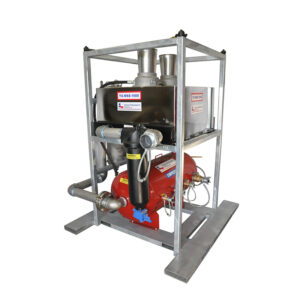
Every compressor makes water. Cooling air squeezes it out as condensate that travels down the hose and reaches the tool as rust, washed-out lubricant and a ruined blast finish. A moisture separator takes it out first. The Texas Pneumatic 1600 CFM moisture separating system uses four levels of separation plus a deliquescent desiccant stage for added drying, has no moving parts to maintain, and feeds several outlets at once so a sandblast or breaker crew can tie in off one unit. It is built to run with additional air manifolds or portable FRL systems downstream of your air compressor. Ships from Denver at a flat freight rate. See the Texas Pneumatic separation line.
Showing the single result
Showing the single result
Four Stages, Nothing to Wear Out
The system pulls moisture out of the compressor discharge across four levels of separation, then finishes with a deliquescent desiccant bed for the vapor mechanical separation leaves behind. Because there is no motor, no float and no timer, service is limited to draining the unit and replacing desiccant — useful on a jobsite where a failed electric dryer would take the whole air system down with it.
Where It Sits in the Air System
Order of operations matters. Air leaves the compressor hot and wet, gives up heat and volume in an air receiver tank, then passes through the separator before it is split out to tools. Put the separator downstream of storage and upstream of distribution and the water drops out where you can drain it instead of at the far end of a 200 ft hose.
What Wet Air Costs
Water in the line rusts tool internals, strips lubricant off vanes and pistons, and freezes in the exhaust of a pneumatic breaker or drill on a cold morning. On blasting and paint work it flash-rusts the substrate and blotches coatings. Dry air also protects the fittings and whips in your air hose fittings and keeps oilers metering properly.
Common Questions
Why do I need moisture removal for compressed air? Because compressing air concentrates the water already in it, and cooling drops that water back out as liquid. Left in the line it corrodes tools, contaminates finishes and freezes exhaust ports. A separator removes it at one point instead of at every tool.
Is a moisture separator the same as an air dryer? Not quite. Mechanical separation knocks out bulk liquid; a desiccant stage takes down the vapor that survives it. This unit does both in one housing, which is why it is sold as a separation system rather than a simple water trap. Compare the drying and filtration options on the air compressor accessories page.
Do I need one for sandblasting? Yes — moisture is the usual cause of clumping media, inconsistent pattern and flash rust on freshly cleaned steel. Feed the pot through the separator, then distribute with a manifold. For capturing the dust that comes back at you, see dust collection systems.
What size compressor does it handle? The system is rated to 1600 CFM, so it covers a single large portable or a bank of machines. Match it against the delivered output of your diesel compressor and start with the air compressor buyer’s guide if you are still sizing the supply side.