
Texas Pneumatic Moisture Separation Systems
TX-MSS separators take four passes at the water in your compressed air and add deliquescent desiccant for final drying. No moving parts to maintain, multiple outlets, and sizes to 1,600 CFM.
The short version
Water in compressed air ruins tools, flash-rusts blast work, ruins a paint finish and freezes lines in cold weather. The TX-MSS eliminates moisture from the compressor with four levels of separation and a deliquescent desiccant stage for added drying, with no moving parts to maintain and multiple outlets so it doubles as a distribution point. Three sizes: 400 CFM (15 gal, 424 lb), 800 CFM (30 gal, 526 lb) and 1,600 CFM (60 gal, 1,235 lb). Use it in combination with additional air manifolds or portable FRL systems. All-brands: moisture separation systems. Storage upstream: air receiver tanks.
TX-MSS moisture separating systems
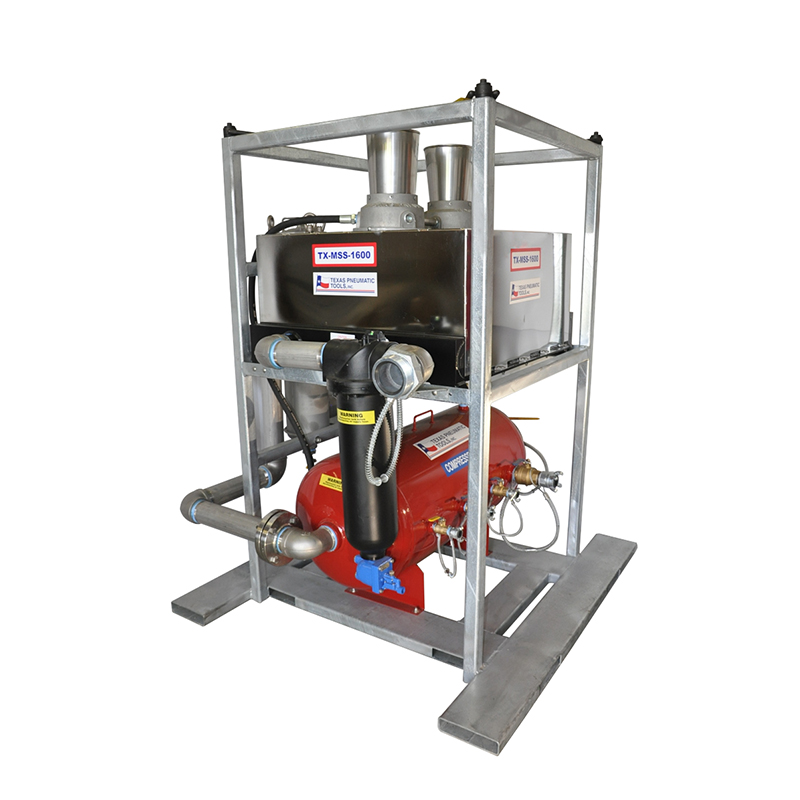
Texas Pneumatic TX-MSS Moisture Separating System
Size it to the compressor’s rated output, not to the tool draw — a separator that is too small simply passes water through at full flow. Multiple outlets mean it can feed the work directly or hand off to a manifold.
400 CFM / 15 gal / 424 lb · 800 CFM / 30 gal / 526 lb · 1,600 CFM / 60 gal / 1,235 lb
Moisture separation questions, answered
What does a moisture separating system do?
Compressed air leaves a compressor hot and saturated. As it cools in the receiver, the hose and the tool, that water condenses out — inside your equipment. The TX-MSS takes it out first, using four levels of separation followed by deliquescent desiccant for final drying, so what reaches the hose is dry enough to blast, paint or run instruments with.
Which size do I need?
Match the separator to the compressor’s rated output in CFM, not to what your tools happen to draw today. A 400 CFM separator on a 750 CFM compressor will be overrun. The three sizes are 400, 800 and 1,600 CFM. Call 1-888-883-5144 with your compressor model.
What maintenance does it need?
There are no moving parts, so the maintenance is draining and replenishing desiccant. That makes it attractive on a jobsite compared to a refrigerated dryer that needs power and service.
Do I still need a manifold or a receiver?
They do different jobs and most systems want more than one. The receiver stores air and starts the cooling process; the separator dries it; the manifold distributes it at the work. Texas Pneumatic specifically recommends using the TX-MSS in combination with additional manifolds or portable FRL systems.
Is it worth it for blasting and painting?
That is the classic case for one. A single droplet of oil or water in the air stream is enough to cause a holiday in a coating or flash-rust a freshly blasted surface, and the rework costs more than the separator. Same logic applies to cold weather: wet air freezes at the tool exhaust and stops work.
How does it ship?
By freight. The smallest unit is 424 lb and the 1,600 CFM system is 1,235 lb. We quote freight with the order and can arrange liftgate delivery. Call 1-888-883-5144 to confirm lead time before a shutdown.
Wet air causing rework?
Give us the compressor’s rated CFM and what you are doing with the air. We will size the separator and tell you where it belongs in the line.