
Hydraulic Concrete & Rock Splitters
Concrete and rock splitters crack boulders, foundations, and mass concrete in seconds without blasting, noise, or vibration. The Tehma SP600, SP400, and Darda C12 drive a wedge between feathers to tear material from the inside, running off a hydraulic power pack for controlled, silent demolition. First drill a hole to the specified size with a rock drill, then set the splitter. Shop the full Darda rock splitter and Tehma rock splitter lines. New to splitting? See our rock splitter buyer’s guide.
Showing all 2 resultsSorted by popularity
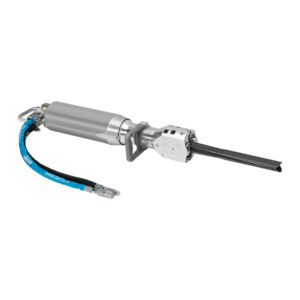
Showing all 2 resultsSorted by popularity
Silent, No-Blast Demolition
Splitters suit quarrying, excavation, and demolition near occupied or sensitive structures where blasting and impact breaking aren’t allowed. Drill a hole, insert the wedge-and-feathers head, and hydraulic force does the rest — no flying debris, no vibration into neighboring structures. Keep wedges and feathers fresh with splitter & crusher accessories.
Drill First, Then Split
Every splitter needs a hole drilled to a specified diameter and depth before it goes in — that’s what sets the wedge. Match a rock drill and rock drill bit to the splitter’s required hole size (see the table below), then drill to at least the minimum depth so the full wedge set seats. For deep or repeated holes, a jackleg or sinker drill speeds the setup.
Splitter Comparison
Match the model to the material and the hole your drill can make — smaller units are portable one-person tools, larger models split big boulders and mass foundations. Larger Darda C-series and Tehma SP-series deliver more splitting force for the toughest work.
| Model | Brand | Drill hole (in) | Min. drill depth (in) | Typical work |
|---|---|---|---|---|
| Darda C2S | Darda | 1.22–1.26 | 10.6 | Concrete, light utility, one-person |
| Darda C4E | Darda | 1.38–1.42 | 16.9 | Concrete slab & small boulders |
| Darda C9 | Darda | 1.77–1.89 | 16.1 | Foundations & medium rock |
| Darda C10S | Darda | 1.61–1.69 | 24.8 | Mass concrete & boulders |
| Darda C12 | Darda | 1.77–1.89 | 24.0 | Large boulders & mass foundations |
| Tehma SP400 | Tehma | 1.8–1.9 | 17.3 | Rock & concrete, quarrying |
| Tehma SP400-SW | Tehma | 1.38–1.42 | 17.3 | Higher force in a smaller hole |
| Tehma SP600 | Tehma | 1.8–1.9 | 25.2 | Large rock & mass concrete |
Check each product page for splitting force and wedge-set details. Darda rates effective force and Tehma rates theoretical force, so compare within a brand.
Shop Splitters by Brand
Compare the line by maker: Darda rock and concrete splitters (the C2S, C4E, C9, C10S, and C12) and Tehma rock and concrete splitters (the SP400, SP400-SW, and SP600). Darda rates effective splitting force and Tehma rates theoretical force, so compare within a brand.
Common Questions
How does a rock splitter work? Drill a hole to the specified diameter and depth with a rock drill, insert the splitter’s wedge-and-feathers head, and hydraulic pressure drives the wedge between the feathers — expanding outward to crack rock or concrete from the inside along the hole line, with no impact or flying debris.
What size hole do I drill? It depends on the model — Darda splitters need roughly 1-1/4 to 1-7/8 in., Tehma SP400/SP600 need about 1.8 in. Each model’s exact diameter and minimum depth are in the table above and on the product page. Undersized or shallow holes won’t seat the wedge.
What’s the difference between a rock splitter and a breaker? A splitter cracks material silently with hydraulic pressure and no vibration — ideal near occupied buildings; a paving breaker breaks by impact, faster in the open but with noise and vibration. See the rock splitter buyer’s guide.
What powers a concrete splitter? Darda and Tehma splitters run off a hydraulic power pack. Match the pack’s flow and pressure to the splitter model. Replacement wedges and feathers are on the splitter & crusher accessories page.