
Chicago Pneumatic BRK Hydraulic Paving Breakers
Four hydraulic breakers from 50 lb to 85 lb, $2,467 to $2,898. 5 to 10 GPM at 1,500 to 1,885 psi, HTMA class I and II, running off a power pack, a skid steer or a utility truck circuit.
The short version
Hydraulic breakers hit harder than air breakers of the same weight, because oil carries far more energy per unit of flow than compressed air does and none of it is lost to compression. A 50 lb BRK 40 does the work of a considerably heavier pneumatic tool. Match on flow first: the BRK 40 and the BRK 25 pick hammer want 5 GPM and HTMA class I; the BRK 55 and BRK 70 want 8 GPM and adjust down to 5; the BRK 95 wants 8 to 10 GPM and class II. Then match the power pack to the tool, not the other way round.
The CP BRK Breaker Line
Four tools, one hydraulic standard. All four run flat-face HTMA quick-release couplings and all four take the same hex working steel as the pneumatic breakers, so an existing rack of points and chisels carries straight over.
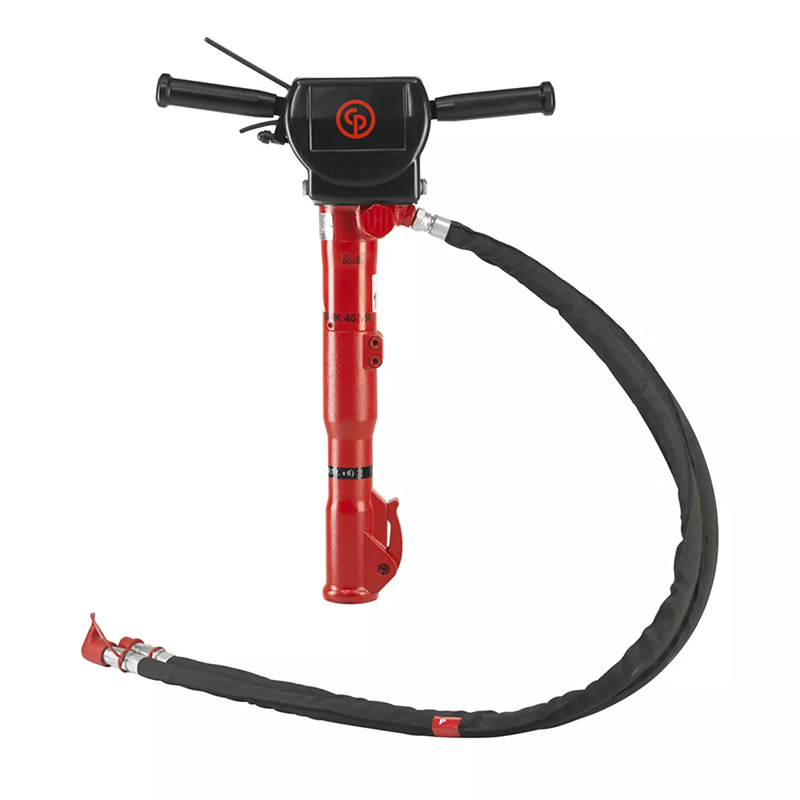
BRK 40 · 50 lb · HTMA class I · 5 GPM
5 GPM · 1,500 to 1,800 psi · 1,400 BPM at 5 GPM · 50 lb · 26 in. · HTMA class I · 145 psi max return · 5.0 m/s2 vibration
The 5 GPM breaker, and the one that runs off the smallest power pack or an existing class I circuit on a skid steer or utility truck. 50 lb, 26 in., 1,400 blows a minute, and the lowest vibration in the line at 5.0 m/s2. Three shank sizes.
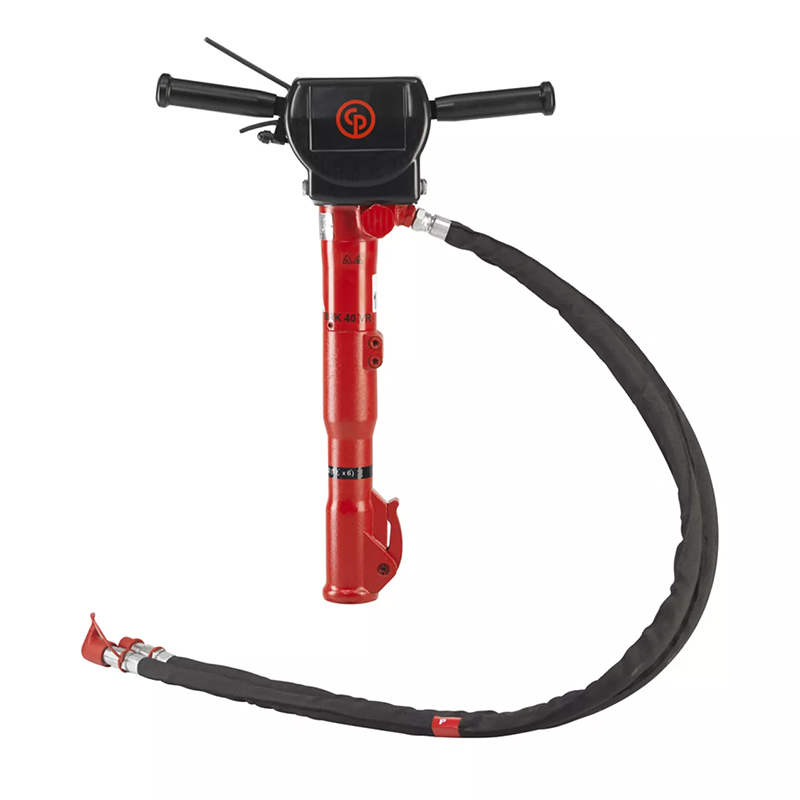
BRK 55 · 62 lb · HTMA class II · 8 GPM
8 GPM, adjustable to 5 · 1,668 to 1,885 psi · 2,100 BPM at 8 GPM · 62 lb · 27 in. · HTMA class II or I · 5.0 m/s2
The fastest breaker in the hydraulic line: 2,100 blows a minute at 8 GPM, 62 lb and 27 in. It can be adjusted down to 5 GPM to run on a class I circuit, which makes it the most flexible of the four if your fleet has both.
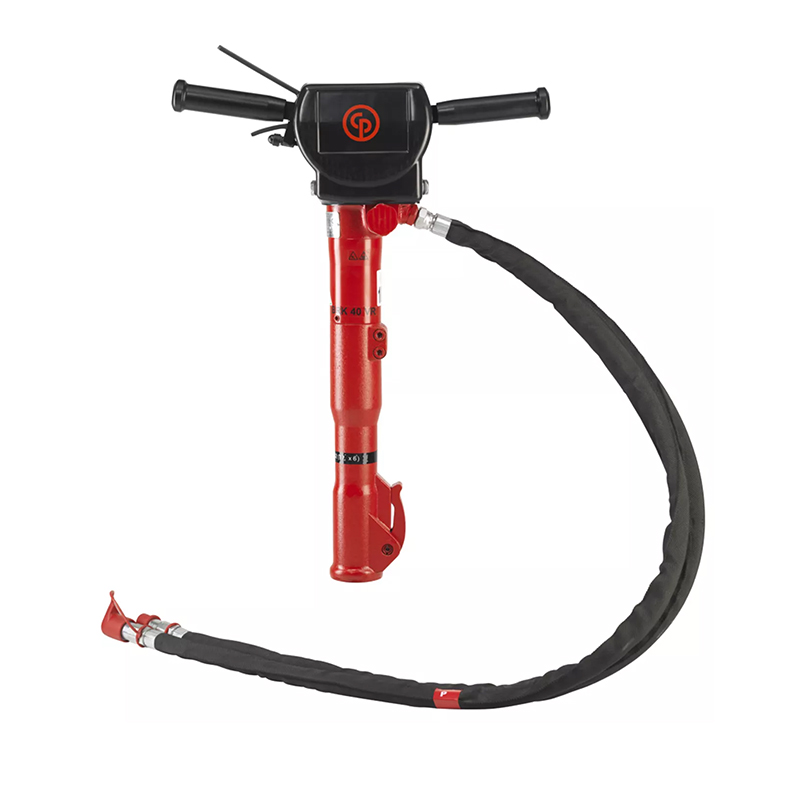
BRK 70 · 72 lb · HTMA class II · 8 GPM
8 GPM, adjustable to 5 · 1,668 to 1,885 psi · 1,750 BPM at 8 GPM · 72 lb · 30 in. · HTMA class II or I · 5.8 m/s2
Where the hydraulic line starts hitting like a 70 lb air breaker. 72 lb and 30 in. at 1,750 blows a minute on 8 GPM, adjustable to 5. Heavier than the BRK 55 and slower per blow, which is exactly what thick slab and footings want.
BRK 95 · 85 lb · HTMA class II · 8 to 10 GPM
8 GPM, adjustable to 10 · 1,668 to 1,885 psi · 1,150 BPM at 8 GPM, 1,600 at 10 · 85 lb · 30 in. · HTMA class II · 6.4 m/s2
The heavy one. 85 lb and 30 in. at 1,150 blows a minute on 8 GPM, or 1,600 when fed 10. This is the hydraulic answer to a 90 lb air breaker: mass demolition, thick footings and heavily reinforced concrete, off a power pack you can wheel to the work.
Why Hydraulic Instead of Air
Three real differences, and one that matters more than the other two.
More energy into the steel
Compressed air loses a large share of its energy to compression and expansion before it ever reaches the piston. Oil does not. That is why a 50 lb hydraulic breaker competes with a much heavier air tool, and why hydraulic tools are quieter and produce no exhaust blast of oily air at the working face.
It runs off machines you already own
Any skid steer, mini excavator, tractor or utility truck with an auxiliary circuit at the right flow will drive a BRK. No compressor, no second machine. Where there is no carrier, a petrol power pack fills in.
CP hydraulic power packsConfined and indoor work
No exhaust at the tool and far less noise than a compressor plus an air breaker makes hydraulic the default for basements, tunnels, plant interiors and anywhere ventilation is the constraint.
What you give up
Cost per tool is higher than air, the hoses are heavier to drag than an air line, and a leak is oil rather than air. On an open site with a crew and a compressor already there, pneumatic is still the cheaper way to break concrete.
CP pneumatic paving breakersCompare All Four Breakers
Factory figures from the Chicago Pneumatic hydraulic breaker datasheet. Vibration is quoted to ISO 8662-5 and CP publish it in metric only, so it is reproduced as printed.
| Model | Weight | Length | Oil flow | Working pressure | Max return | Impact rate | HTMA class | Vibration | Shanks | Price |
|---|---|---|---|---|---|---|---|---|---|---|
| BRK 40 | 50 lb | 26 in. | 5 GPM | 1,500 to 1,800 psi | 145 psi | 1,400 BPM at 5 GPM | I | 5.0 m/s2 | 1 x 4-1/4, 1-1/8 x 6, 1-1/4 x 6 | $2,467 |
| BRK 55 | 62 lb | 27 in. | 8 GPM, adj. to 5 | 1,668 to 1,885 psi | 510 psi | 1,500 at 5 GPM, 2,100 at 8 | II or I | 5.0 m/s2 | 1 x 4-1/4, 1-1/8 x 6, 1-1/4 x 6 | $2,636 |
| BRK 70 | 72 lb | 30 in. | 8 GPM, adj. to 5 | 1,668 to 1,885 psi | 510 psi | 1,350 at 5 GPM, 1,750 at 8 | II or I | 5.8 m/s2 | 1-1/8 x 6, 1-1/4 x 6 | $2,724 |
| BRK 95 | 85 lb | 30 in. | 8 GPM, adj. to 10 | 1,668 to 1,885 psi | 300 psi | 1,150 at 8 GPM, 1,600 at 10 | II | 6.4 m/s2 | 1-1/8 x 6, 1-1/4 x 6 | $2,898 |
Swipe the table sideways to see every column.
Watch the maximum return line pressure. It is the specification people forget and the one that kills seals. The BRK 40 tolerates 145 psi on the return, the BRK 55 and BRK 70 tolerate 510, and the BRK 95 drops back to 300. If you are plumbing into an existing carrier circuit, check the return restriction before you connect the tool, not after.
Impact rate is quoted at a flow, not on its own. A BRK 55 runs 1,500 blows a minute on 5 GPM and 2,100 on 8. Feeding a tool less than its rated flow does not break it, it just slows it down, which is exactly what the adjustable models are for.
Flow, Pressure and HTMA Class
Getting this right is most of the job. Every CP hydraulic tool states a class and every CP power pack states what it delivers, so the matching is arithmetic rather than guesswork.
HTMA class is the thing to get right. The Hydraulic Tool Manufacturers Association standardised circuit ratings so a tool from one maker runs off a pack from another. Class I is 5 GPM at 2,000 psi and class II is 8 GPM at 2,000 psi. Feed a class I tool from a class II circuit without a flow restrictor and you overspeed it; feed a class II tool from a class I circuit and it runs slow and hot. Every CP tool on this site states its class, and every CP pack states what it delivers.
| Tool | Flow needed | Class | PAC P9 (5 GPM) | PAC P13 (5 to 8 GPM) |
|---|---|---|---|---|
| BRK 25 pick hammer | 5 GPM | I | Yes | Yes |
| BRK 40 breaker | 5 GPM | I | Yes | Yes |
| BRK 55 breaker | 8 GPM, adjustable to 5 | II or I | At reduced output | Yes |
| BRK 70 breaker | 8 GPM, adjustable to 5 | II or I | At reduced output | Yes |
| BRK 95 breaker | 8 GPM, adjustable to 10 | II | No | Yes, at 8 GPM |
| PDR 30T post driver | 5 GPM | I | Yes | Yes |
| PDR 75RV post driver | 5 to 8 GPM | I or II | At reduced output | Yes |
| PDR 95R post driver | 8 to 10 GPM | II | No | Yes, at 8 GPM |
Swipe the table sideways to see every column.
Running off a carrier rather than a pack. A skid steer, mini excavator, tractor or utility truck with an auxiliary hydraulic circuit will drive these breakers provided the flow, the working pressure and the return restriction all fall inside the tool spec. Check all three. Most carriers deliver far more flow than a hand tool wants, which is what a flow restrictor is for.
Couplings. The BRK line uses flat-face HTMA quick-release couplings, which is the industry standard and which is why a CP breaker will run off another manufacturer’s pack. Hoses are not included with the tool.
Shanks and Working Steel
This is where hydraulic and pneumatic converge. The BRK breakers take the same hex working steel as the CP air breakers, so a yard that already runs air tools does not need a second rack of points.
| Shank size | Fits | Typical use |
|---|---|---|
| 1 x 4-1/4 in. | BRK 40, BRK 55 | The light shank. Also fits the CP 0112 and CP 1210 air breakers. |
| 1-1/8 x 6 in. | BRK 40, BRK 55, BRK 70, BRK 95 | The most widely stocked heavy shank in North America. |
| 1-1/4 x 6 in. | BRK 40, BRK 55, BRK 70, BRK 95 | The heaviest shank on the line. Longest life under abuse. |
| 7/8 x 3-1/4 in. | BRK 25 pick hammer | The pick hammer runs its own smaller shank. |
Swipe the table sideways to see every column.
We stock our own points, chisels, spades and cutters in every one of these shank sizes rather than reselling manufacturer ordering numbers — points and chisels from $30 and blade tools from $131. Order by shank and length; the steel does not care whether the hammer behind it runs on oil or air.
Chicago Pneumatic Hydraulic Breaker FAQ
What is the difference between a hydraulic and a pneumatic paving breaker?
Where the energy comes from and how much of it reaches the steel. Compressed air loses a large share of its energy to compression and expansion; hydraulic oil does not. The result is that a 50 lb hydraulic breaker competes with a noticeably heavier air breaker, runs quieter, and produces no blast of oily exhaust at the working face. The trade is a higher price per tool, heavier hoses, and the need for a pack or a carrier circuit rather than a compressor.
What is HTMA class and why does it matter?
The Hydraulic Tool Manufacturers Association standardised circuit ratings so tools and power sources from different makers work together. Class I is 5 GPM at 2,000 psi; class II is 8 GPM at 2,000 psi. Feed a class I tool from a class II circuit without a restrictor and you overspeed it. Feed a class II tool from class I and it runs slow. Match the class, then check the maximum return line pressure as well.
Which CP hydraulic breaker should I buy?
Start from the flow you have. On 5 GPM, class I, the BRK 40 is the tool. On 8 GPM the BRK 55 is the fastest at 2,100 blows a minute, the BRK 70 is heavier and better on thick slab, and the BRK 95 at 85 lb is the mass demolition tool. The BRK 55 and BRK 70 both adjust down to 5 GPM, so they are the safer buy for a mixed fleet.
Can I run a BRK breaker off my skid steer or excavator?
Yes, if the auxiliary circuit matches. Check three things: flow within the tool’s range, working pressure within 1,500 to 1,885 psi, and return line restriction below the tool’s maximum, which is 145 psi on the BRK 40, 510 on the BRK 55 and BRK 70 and 300 on the BRK 95. Most carriers deliver more flow than a hand tool wants, so a flow restrictor is usually part of the answer.
What power pack do I need?
The PAC P9 at a flat 5 GPM drives the BRK 25 and BRK 40. The PAC P13 at 5 to 8 GPM drives every breaker on this page, including the BRK 95 at its 8 GPM setting. If you want the BRK 95 at its full 10 GPM you are into the larger PAC P18. Full range on the power packs page.
What working steel fits them?
The same hex steel as the CP pneumatic breakers: 1 x 4-1/4 in. on the BRK 40 and BRK 55, and 1-1/8 x 6 in. and 1-1/4 x 6 in. across the line. We stock our own moil points, chisels, clay spades, asphalt cutters and bushing tools in all of those sizes from $30.
Are hoses included?
No. Chicago Pneumatic supply the breakers without hoses. The line uses flat-face HTMA quick-release couplings, which is the industry standard, so existing hoses will usually connect. Call 1-888-883-5144 and we will quote hoses with the tool if you need them.
Do you stock these?
Yes, all four, shipping the same day on orders placed by 4 PM Eastern. Add a shank size to the cart above, or call 1-888-883-5144 if you want the breaker, a power pack and the steel quoted together.
Hydraulic breakers and power packs in stock
Tell us what flow you have available and what you are breaking, and we will match the breaker, the pack and the steel.