

Texas Pneumatic Air Manifolds
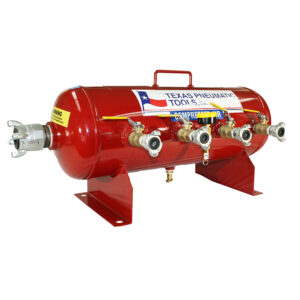
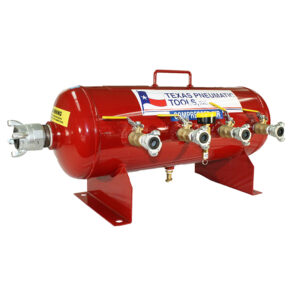
An air manifold takes one line off the compressor and divides it into several valved outlets, so every hose gets its own shutoff instead of a nest of tees. Texas Pneumatic builds them as small galvanized pressure vessels in 2.5 gallon, 10 gallon, 15 gallon, 30 gallon and 60 gallon sizes, all ASME coded and stamped and built to OSHA guidelines for compressed air storage devices. The round body rolls into position one-handed and stacks for storage, a relief valve caps overpressure, and the drain port bleeds water out of the shell. Feed it from an air compressor, back it with an air receiver tank, and run a bank of jackhammers off one supply. See the full Texas Pneumatic air manifold line.
Showing all 2 resultsSorted by popularity
Showing all 2 resultsSorted by popularity
Pick the Capacity to the Crew
Capacity is the buffer sitting behind the outlets. The 2.5 gallon unit is a carry-it-with-you jobsite splitter for a couple of hoses. The 10 and 15 gallon tanks suit a small crew. The 30 and 60 gallon manifolds feed a full line of tools without the outlets robbing each other when two operators trigger at the same time. The 10 gallon model is built California permit exempt, which matters if the tank travels into that state.
Inlets, Outlets and Fittings
The 2.5 gallon takes a 2-prong crowfoot inlet; the 10, 30 and 60 gallon tanks take a 4-prong crowfoot. Outlets use a safety auto-exhaust ball valve with a locking handle ahead of 2-prong crowfoot connections, with 4-prong outlets added on the 30 and 60 gallon shells. The 2.5 gallon is also built with 1/4, 3/8 and 1/2 in. quick-connect fittings, and any manifold can be configured with other fitting types on request. Confirm the couplers against your air hose fittings before ordering.
Compressed Air Manifold Comparison
Same construction across the line — galvanized ASME shell, relief valve, drain port — so the choice comes down to buffer volume and the fittings you want on it.
| Model | Capacity | Inlet | Outlets |
|---|---|---|---|
| TX-3AMF | 2.5 gal | 2-prong crowfoot | Ball valve & 2-prong crowfoot; 1/4, 3/8 & 1/2 in. quick-connect versions |
| TX-6AMF | 10 gal | 4-prong crowfoot | Ball valve & 2-prong crowfoot; California permit exempt; optional cage |
| TX-2AMF | 15 gal | Configured to order | Configured to order; optional valve cage |
| TX-4AMF | 30 gal | 4-prong crowfoot | Ball valve, 2-prong & 4-prong crowfoot |
| TX-5AMF | 60 gal | 4-prong crowfoot | Ball valve, 2-prong & 4-prong crowfoot |
All five are on this page. The 60 gallon unit moves on flat-rate freight; the smaller shells ship from Denver.
Manifold or Receiver Tank
Two different jobs. A receiver is plumbed at the compressor to store volume for the whole system; a manifold sits out at the work and divides that supply into controlled, individually valved outlets. The shell does double duty as a knockout pot, letting particulates and water fall out of the main line instead of running down the hose, but it is not a replacement for real moisture separation ahead of sensitive tools.
Common Questions
How many tools can be connected to an air manifold at once? As many as it has outlets, but the real limit is compressor output. Add up the CFM of every tool that will run together and size the compressor to that total — the manifold divides air, it does not create it.
What is a shop air manifold? A small pressure vessel with one inlet and several valved outlets. It gives each hose its own shutoff, buffers pressure so one tool starting does not drop another, and collects moisture and debris out of the supply line.
Are these pneumatic tank manifolds ASME certified? Yes. Every tank is ASME coded and stamped and meets OSHA guidelines for compressed air storage devices. The 10 gallon version is additionally built California permit exempt.
Do I still need a receiver if I have a manifold? Usually. Use an 80 to 400 gallon receiver at the compressor for system storage, and the manifold at the work for distribution. See the full air movement & storage range.