
Air Receiver Tanks
An air receiver tank banks compressed air between the compressor and the hose, so line pressure holds when a crew opens several tools at once. Texas Pneumatic builds three capacities — the 80 gallon at 20 × 63 in. and 214 lb, the 120 gallon at 24 × 67 in., and the 400 gallon at 36 × 93 in. and 925 lb — each one ASME coded and stamped for 200 psi working pressure. Stored air keeps an air compressor from short-cycling, absorbs the spike when a paving breaker or blast pot loads the line, and gives water somewhere to fall out before it reaches the tool. Split the supply with air manifolds and dry it with moisture separation systems, or see the full Texas Pneumatic receiver tank line. Ships from Denver.
Showing all 2 resultsSorted by popularity
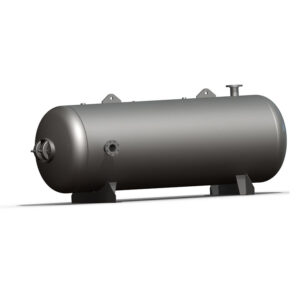
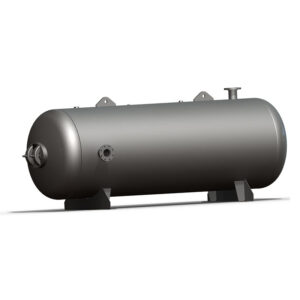
Showing all 2 resultsSorted by popularity
What a Receiver Tank Does
A receiver stores air, it does not make it. Holding a volume at pressure lets the compressor answer average demand instead of every peak — the 80 gallon body carries 10.7 cubic feet of interior volume and the 120 gallon carries 16. That reserve flattens the pulsation the compression cycle puts into the line, cuts start-stop wear on the pump, and stops a chipping hammer or spray gun from starving the moment another outlet opens.
Air Receiver Tank Sizing
Size to the worst intermittent draw, not the average. A shop running one or two hand tools and a paint gun is covered by the 80 or 120 gallon tank. Sandblasting, multi-tool crews, and anything with a long continuous pull want the 400 gallon body. Check the footprint too — these are horizontal tanks, so length is usually the constraint, not height.
| Model | Capacity | Tank dia. × length | Weight |
|---|---|---|---|
| TP 80 Gal Horizontal | 80 gal | 20 × 63 in. | 214 lb |
| TP 120 Gal Horizontal | 120 gal | 24 × 67 in. | 311 lb |
| TP 400 Gal Horizontal | 400 gal | 36 × 93 in. | 925 lb |
Legs add 2-5/16 in. to the 80 gallon tank, 2-1/4 in. to the 120, and 3 in. to the 400. All three are on this page.
Horizontal or Vertical
A horizontal air receiver sits low on legs and tucks against a wall or under a mezzanine, which is why it is the default in most shops. A vertical air receiver tank gives up wall length for floor space and puts the drain at the bottom of a tall column, so condensate collects in one place. Each capacity above is listed in both configurations — choose on the product page. For truck and towable units with the tank built in, see air compressors.
Drains, Fittings and Finish
Air cools inside the tank and water drops out, so the low-point drain gets blown down on a schedule or the reserve turns into a rust pot. Openings and their locations are on each spec sheet. Tanks ship with an exterior primer coat only, so plan a topcoat if it lives outdoors. For dry air at the tool, run a separator and a set of filters, regulators and lubricators downstream of the tank.
Common Questions
What size air receiver tank do I need for my air compressor? Match it to peak draw and duty cycle rather than compressor horsepower. Intermittent hand-tool and paint work runs fine on 80 or 120 gallons; continuous demand like blasting wants 400. Tell us your tool list and we will size it — the air compressor buyer’s guide works through the CFM math.
What is the difference between a horizontal and a vertical air receiver tank? Only the orientation of the same pressure vessel. Horizontal takes wall length and stays low; vertical takes a smaller footprint and stands tall. Storage volume, the 200 psi rating, and the ASME stamp are identical.
Are these compressed air storage tanks ASME coded? Yes. Every tank is ASME coded and stamped with a 200 psi working pressure, which is what most jurisdictions and insurers ask for on a permanent shop air receiver.
Do you sell the manifolds and separators that go with it? Yes — galvanized air manifolds divide the supply out at the work, and the rest of the air movement & storage range covers ducting, blowers and separators.