

Texas Pneumatic Jet Fans
A jet fan drives a tight column of air down a tunnel, tank or vault using compressed air jets on the blades instead of a motor. The Texas Pneumatic jet fan is a four-blade vane axial unit in a rugged cast-aluminum housing with a cast-aluminum blade; air jets on the trailing edge of two of the four blades spin the wheel, so the shaft transmits no power and carries no torque. Only the shaft, bearings and blade rotate. Airfoil blade sections and bolt-on guide vanes take the swirl out of the discharge and raise efficiency, and performance was measured at an independent lab to AMCA Standard 210. It runs as a ventilation blower or as an exhauster. Compare tornado blowers and venturi air movers, or see the whole Texas Pneumatic jet fan line.
Showing the single result
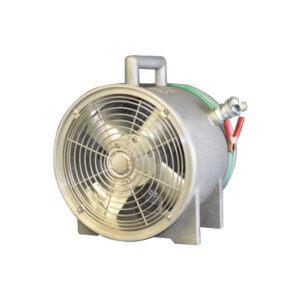 Price range: $2,700.00 through $6,250.00 Select options This product has multiple variants. The options may be chosen on the product page
Showing the single result
How the Air Drives the Blade
Compressed air is piped into the hub and leaves through jets on the trailing edge of two blades. The reaction spins the wheel, so unlike a normal fan the shaft never transmits power to the blade. That leaves the shaft, bearings and blade as the only moving parts, with no motor, gearbox or electrical connection to certify in a classified space. The four-blade layout also makes its flow at lower rpm, which is what stretches bearing life on this design.
Sizes and Guide Vanes
The line runs 12, 16, 20 and 24 in. Bigger wheels move more air and push against more system resistance — the blades develop enough static pressure to overcome the resistance of the space being ventilated rather than just stirring the opening. Guide vane attachments neutralize the spin coming off the blades and turn the flow axial, which is what makes a long air ducting run behave. Pick the diameter to the duct you intend to hang on it, then feed it from an air compressor with margin.
Blower, Exhauster and Shipboard Mounting
Reverse the setup and the same fan pulls fumes and stale air out of a compartment instead of pushing fresh air in, which is standard practice for gas-freeing a tank before entry. For marine work an optional TX-JFBFA adapter plate lets the fan bolt to Butterworth flanges onboard ship. Where no compressed air is available, the water-driven marine blower covers the same duty off a fire hose.
Jet Fan, Air Mover or Man Cooler
Three different tools. A venturi air horn has no moving parts at all and suits short-throw ventilation and gas freeing. A jet fan is a bladed axial machine that builds static pressure, so it pushes air through duct and down long runs. A man cooler is an electric floor fan for cooling people in a plant, not for ducted ventilation. For dust captured at the tool, see dust collection systems.
Common Questions
What is a ventilation jet fan? A high-velocity axial fan that throws a concentrated column of air rather than a wide, soft flow. It is used to ventilate tunnels, tanks, vaults and ship compartments, and to exhaust hazardous fumes out of them. This one is driven by compressed air rather than an electric motor.
What size industrial jet fan do I need? Match the wheel to the duct and the length of the run: 12 and 16 in. for compartments and short duct, 20 and 24 in. where the run is long or the resistance is high. Add guide vanes when the discharge has to travel.
Can a jet fan be used as an exhauster? Yes. The same unit works as a blower or an exhauster — turn it around and it pulls the atmosphere out of the space instead of pushing fresh air in.
How much air does it consume? Consumption depends on wheel size and inlet pressure, and is listed on the spec sheet for each size. Size the supply to that figure, and keep it clean with moisture separation. See the rest of the air movement & storage range for ducting and coolers.