
Chicago Pneumatic Pneumatic Nutrunners
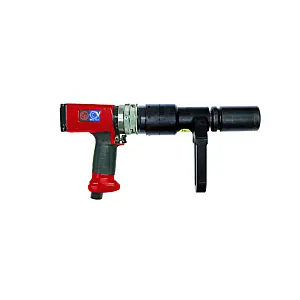
Two nutrunner families for torque-controlled production bolting: the CP7600C BlueTork at 664 ft-lb with preset torque control, and the CP6613 line running 959 to 3,020 ft-lb in 3/4 and 1 in. drive. A nutrunner is not an impact gun — it pulls the joint smoothly to a set torque and stops, cycle after documented cycle.
The short version
An impact wrench approximates torque; a nutrunner delivers it. Continuous rotation, gear reduction, and a reaction bar produce accurate, repeatable, quiet bolting — flanges, structural joints, and any assembly where the torque number is contractual. Pick the CP7600C BlueTork for 664 ft-lb production duty or the CP6613 family up to 3,020 ft-lb; both configure by reaction bar and kit. For lower-torque assembly with the same philosophy see shut-off screwdrivers; for battery versions see cordless tools. Joint questions: 1-888-883-5144.
CP7600C BlueTork & CP6613 Pneumatic Nutrunners
Gear-driven continuous rotation to a set torque — no impacts, no scatter, no operator judgment in the number.
Torque-controlled bolting
The BlueTork CP7600C is the production workhorse: 664 ft-lb, presets, and reaction-bar options for repetitive flange and structural work. The CP6613 family steps up through 959, 1,920, and 3,020 ft-lb versions, tool-only or kitted with an air torque controller and FRL for a complete calibrated station.
Nutrunner · 1 in. Drive · BlueTork
664 ft-lb · 100 rpm
Torque-controlled production bolting with documented results.
Configuration
Nutrunner · 3/4 & 1 in. Drive
959-3,020 ft-lb · 10-20 rpm
Heavy flange and structural bolting; kits add ATC and FRL.
Torque / Drive
Pneumatic Nutrunners — Common Questions
What is a nutrunner and how is it different from an impact wrench?
A nutrunner turns the fastener continuously through gear reduction and stops at a set torque — smooth, quiet, and repeatable, with the reaction taken by a bar instead of your wrists. An impact wrench hammers: fast and powerful, but the delivered torque scatters widely. When the drawing carries a torque number that gets audited, the nutrunner is the tool that satisfies it.
What does the reaction bar do?
At 664-3,020 ft-lb, something has to absorb the torque that is not the operator. The reaction bar braces against an adjacent nut, flange edge, or structure, so the operator just holds the trigger. Blade and cup styles suit different joints — that is the main thing the CP7600C configurations change, and we will match the bar to your flange pattern.
How accurate is a pneumatic nutrunner?
With regulated air and a calibrated setup, repeatability on a consistent joint is in the low single-digit percent range — a different universe from an impact gun. The CP6613 kit versions ship with an air torque controller and FRL because the accuracy assumption is stable inlet pressure; that is the complete calibrated station for contractual bolting.
Impact wrench, nutrunner, or torque wrench?
Speed, spec, or check — in that order. Run fasteners down fast with an impact wrench; pull audited joints to spec with a nutrunner; verify with a click or electronic torque wrench. High-cycle plants use all three in one bay. For field joints without air, the CP86 battery torque wrenches carry the same discipline on a battery.
Bolting to a Contractual Torque Spec?
Tell us the joint, the spec, and the cycle count and we will configure the nutrunner, reaction bar, and FRL package.