
Chicago Pneumatic Air Screwdrivers
Thirteen pneumatic screwdriver models across four clutch types — direct drive, cushion clutch, impact, and shut-off. The clutch is the whole decision: it determines whether final torque comes from the operator’s wrist or lands on the same documented value every cycle.
The short version
Match the clutch to the joint. Direct drive: fastest and cheapest, torque is the operator’s problem. Impact: drives hard joints without wrist reaction. Cushion clutch: softens the seat so gaskets and plastics survive. Shut-off clutch: the motor stops itself at preset torque — what assembly lines with a torque spec buy. All thirteen are in the screwdrivers category; for documented high-torque bolting see nutrunners. Spec help: 1-888-883-5144.
Direct Drive Air Screwdrivers
No clutch between motor and bit — the fastest, simplest, cheapest way to run fasteners when seating feel is the operator’s job.
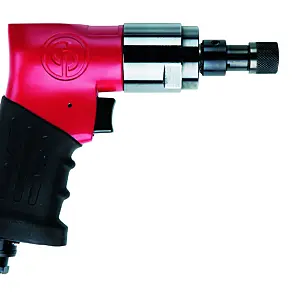
Speed first, operator-controlled torque
Direct drive suits self-tapping screws into sheet, rough assembly, and any joint where the operator judges the seat. The CP2755 and CP2765 are the bench standards; the industrial CP2810/CP2811 add governed motors and pistol or straight bodies for line duty.
Direct Drive
900-2,200 rpm · 1/4 in. hex
Fast, low-cost driving where the operator controls final torque.
Max torque
Positive Drive
2,100 rpm · 7.4 ft-lb
Positive-drive action for self-tappers and rough assembly.
Max torque
Direct Drive · Industrial
750-2,400 rpm · straight or pistol
Industrial-line direct drive for continuous production shifts.
Handle
Impact Air Screwdrivers
Rotary hammer blows drive stubborn fasteners with almost no reaction torque back into the operator’s wrist.
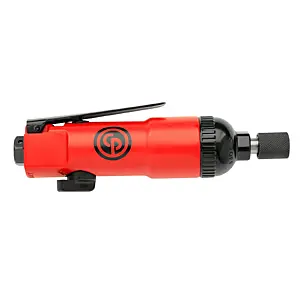
Hard joints without wrist reaction
An impact screwdriver delivers torque in blows, so the tool never winds up against the operator — the answer for hard joints, thread-formers, and repair work on seized small fasteners. Not for torque-critical joints; the blows defeat repeatability.
Impact Screwdriver
10,000 rpm · 1/4 in. hex
Driving into hard joints without the reaction an inline driver puts on the wrist.
Speed
Impact Screwdriver · Heavy
13,000 rpm · 1/4 in. hex
Higher-capacity impact driver for larger production fasteners.
Speed
Cushion Clutch Air Screwdrivers
A slip clutch softens the instant the fastener seats — gaskets, plastics, and painted surfaces survive.
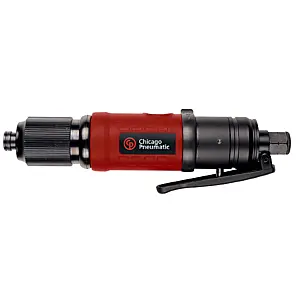
Protecting the joint at seat
The cushion clutch slips at seating instead of slamming, which protects gasketed and plastic joints while keeping cycle speed. The CP2623 is the bench pick; the CP780/781/782 family and industrial CP2812/CP2816 cover higher torque bands for line work.
Cushion Clutch
1,700 rpm · 1/4 in. hex
Softens the seat so gaskets and plastics are not crushed.
Clutch
Cushion Clutch
1,800 rpm · 3.7 ft-lb
Light-torque cushion driver for small production fasteners.
Max torque
Cushion Clutch · Heavy
1,700 rpm · 1/4 in. hex
Heavier cushion-clutch driver for larger assembly fasteners.
Clutch
Cushion Clutch · Low Speed
800 rpm · 1/4 in. hex
Low-speed control for delicate or deep-thread joints.
Speed
Cushion Clutch · Industrial
950-1,300 rpm · straight or pistol
Industrial-line cushion clutch for continuous production.
Handle
Shut-Off Clutch Air Screwdrivers
The motor stops itself at the preset torque — every fastener lands on the same value, cycle after cycle.
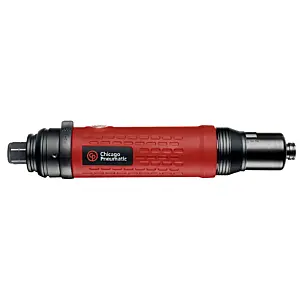
Repeatable torque, documented joints
A shut-off clutch cuts air the instant the set torque is reached: no operator judgment, no over-drive, and a clean torque audit trail. This is what production lines with a documented torque spec buy. The industrial CP2814 family tops the range.
Shut-Off Clutch
1,000-1,700 rpm · 1/4 in. hex
Torque-spec assembly — the motor stops itself at the set value.
Speed
Shut-Off Clutch · Valve
1,000 rpm · shut-off valve
Pneumatic-valve shut-off for tight torque scatter.
Clutch
Shut-Off Clutch · Industrial
1,100-1,500 rpm · straight or pistol
The industrial line-duty shut-off driver for documented joints.
Handle
Air Screwdrivers — Common Questions
What is the difference between direct drive, cushion clutch, and shut-off clutch?
Direct drive has no clutch: fastest and cheapest, final torque is whatever the operator feels. A cushion clutch slips as the fastener seats, protecting gaskets, plastics, and paint. A shut-off clutch stops the motor at a preset torque so every fastener lands identically — that is the one to buy when the drawing has a torque number on it.
When is an impact screwdriver the right choice?
Hard joints and stubborn fasteners where an inline driver would twist the operator’s wrist: thread-forming screws into thick sheet, seized small fasteners, repair work. The blows kill torque repeatability, so keep impact drivers off torque-critical joints — use a shut-off driver there instead.
How repeatable is a shut-off clutch, really?
Good enough for most documented assembly: a healthy shut-off driver on a consistent joint holds a tight torque scatter cycle after cycle. What ruins it is inconsistent air pressure and worn clutch parts — regulate the drop to the tool and service the clutch on schedule. For higher-stakes bolting with data capture, step up to nutrunners or the eBlueTork battery wrenches.
What air supply do these need?
Screwdrivers are light drinkers — typically 2-4 CFM at 90 psi in production use, so the compressor is rarely the problem. What matters is a regulated, lubricated drop: torque calibration on clutch tools assumes stable inlet pressure. An FRL unit from filters, regulators and lubricators at each station is the standard setup.
Straight or pistol grip for production work?
Driven by joint orientation: straight bodies suit downward driving on benches and fixtures (and hang naturally from a tool balancer); pistol grips suit horizontal driving into vertical faces. The industrial CP28xx families sell both bodies on the same clutch, so the ergonomics do not force a clutch compromise. Tool balancers are in accessories.
Need Help Matching a Screwdriver to the Joint?
Tell us the fastener, the joint, and the torque spec, and we will pick the clutch with you. All thirteen models ship from Denver stock.