

Chicago Pneumatic Sanders & Polishers
Sanders and polishers do the work after the grinder: blending welds, knocking down body filler, feathering primer, and buffing paint to gloss. Chicago Pneumatic covers it with heavy industrial angle and vertical sanders like the 2.4 hp CP3650 and the 7 and 9 in. CP3850, a body-shop line of random orbital, delta, and mini pistol tools including the CP7215, oil-free machines such as the CP55 that keep oil mist off fresh paint, polishers to 7 in., and belt sanders for weld and rust work in tight spots. Feed them from the abrasives range, keep the dust down with vacuum and dust extraction accessories, and see the full line-up on the CP air sanders and polishers page. For heavy stock removal, cross to air grinders. In-stock items ordered by 4 PM ET ship the same day from Denver.
Showing all 2 resultsSorted by popularity
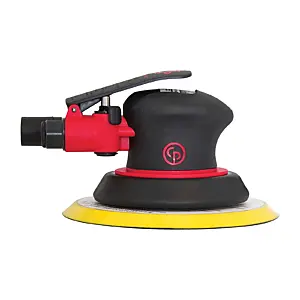
Showing all 2 resultsSorted by popularity
Industrial Sanders vs. the Vehicle-Service Line
CP runs two catalogs here, and they barely overlap. Industrial sanders cover 0.28 to 3.1 hp, 1,000 to 26,000 rpm, 6.4 to 80 CFM, and 3 to 7 in. discs — the 3000-series angle and vertical tools built for weld dressing, foundry cleanup, and heavy surface prep on 1,000 to 2,000 hour service intervals. The body-shop line covers 0.2 to 0.71 hp at 2,100 to 22,000 rpm: lighter palm and pistol tools for filler, primer, and paint. A CP3349 vertical sander and a CP7255 orbital are not substitutes for each other.
Orbital, Rotary, Angle & Belt
Random orbital sanders spin and oscillate at once, so they cut without leaving swirl — the standard for filler and primer. Rotary sanders and mini pistol tools like the CP7200 take 2 and 3 in. pads into small repairs. Angle and vertical sanders load a large disc for fast removal on steel. Belt sanders reach welds, tube, and rust in slots nothing else gets into, and the PL05 runs three belt sizes at 16,000 rpm.
Compare CP Sanders & Polishers
Pad or belt size sets the footprint, motor output sets how hard you can lean on it. These are CP’s published figures by series.
| Model | Type | Pad, disc or belt | Motor |
|---|---|---|---|
| CP3030 | Gearless rotary | 2 in. (50 mm) | 0.7 hp (500 W), 25,000 rpm |
| CP351X | Random orbital | 5 in. (125 mm) | 0.3 hp (210 W) |
| CP7202 | Mini pistol rotary | 3 in. (75 mm) Roloc | — |
| CP7265 | Palm random orbital | 6 in. (150 mm) | 0.29 hp (210 W) |
| CP7269 | Polisher | 7 in. (178 mm) pad, 8 in. flex-edge | 0.7 hp (500 W) |
| CP3119 | Low-speed rotary angle | — | 1.2 hp (900 W) |
| CP3550 | Angle | — | 1.5 hp (1,100 W) |
| CP5080 | Belt | 1/2 x 24 in. (13 x 610 mm) belt | — |
| CP9779/CP9780 | File belt | 3/8 & 3/4 in. (10, 20 mm) belts | — |
Filter the range above by pad size and tool type in the sidebar.
Pads, Dust & Oil-Free Motors
Pads come hook-and-loop or PSA, and a worn pad face ruins a finish faster than a tired motor. Self-vacuum and central-vacuum versions pull dust straight off the disc — important on silica and on paint. Oil-free tools such as the CP53 sander and CP5318 polisher run 2,000 hours without lubricating the motor, so no oil mist lands on the panel. Stock sanding pads and backing plates with the tool.
Common Questions
Where do I find Chicago Pneumatic sander and polisher parts? CP catalogs tune-up kits and spare parts for these series. Start at the parts and diagrams hub, and send the series number off the tool tag if you cannot find your model.
Sander or polisher? Same platform, different speed and pad. Sanders cut with abrasive discs; polishers turn a foam or wool pad slower for compound and wax — the CP7201 uses a 3 in. hook-and-loop pad for spot repair, the CP7269 a 7 in. pad for panels.
Why an oil-free sander? Any oil carried out of a lubricated motor lands on the surface you are about to paint. Oil-free motors remove that risk on prep and pre-polish work while still running 2,000 hours between service.
What compressor keeps up? Sanders draw air continuously rather than in bursts, so size to the tool’s full rating — 6.4 to 80 CFM on the industrial line. See air compressors.