
Chicago Pneumatic Air Sanders & Polishers
Twenty-eight pneumatic sander and polisher models — random orbitals from 2 to 6 in., delta and rotary sanders, belt sanders for seams and tube, and polishers to 8 in. Air sanders run cool, weigh little, and ignore the dust that kills brushed electric motors, which is why the body-shop world never left them.
The short version
Paint prep and panels → random orbital sanders (pick pad size, PSA or hook-and-loop, and vacuum type). Corners, seams, and profiles → the delta and belt sanders. Cut-and-buff → polishers. Continuous industrial finishing → the CP3xxx rotary and angle sanders. Everything is in the sanders and polishers category; sanding media is in abrasives. Vacuum-system questions: 1-888-883-5144.
Random Orbital Air Sanders
2 to 6 in. pads, PSA or hook-and-loop, non-vacuum to central-vacuum — the sanders that do the actual work in a body shop.
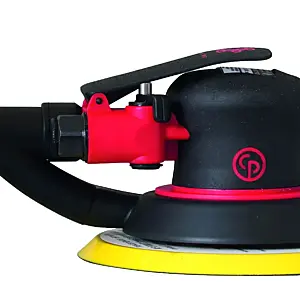
The paint-prep standard
Random orbital motion leaves no swirl pattern, which is why paint prep lives on these tools. The CP7255 family is the mainline choice with ten buildable versions; the CP7200 2 in. spot sander handles feather-edging and small repairs. Vacuum versions keep dust out of the booth and the operator.
Random Orbital · 2 in.
15,000 rpm · 2 in. pad
Spot repair and small-panel feather-edging.
Configuration
Rotary Sander · 3 in.
15,000 rpm · 3 in. pad
Small rotary for fast material removal on spots and edges.
Configuration
Random Orbital · 5 in.
12,000 rpm · 5 in. pad
Compact 5 in. orbital for panel work; PSA or hook-and-loop.
Pad type / Vacuum
Random Orbital · 3-6 in.
12,000 rpm · 3-6 in. pad
The value orbital family — seven versions across pad and vacuum options.
Pad / Pad type
Random Orbital · 6 in.
11,000-12,000 rpm · 6 in. pad
Six-inch panel sander; one or two-hand grip versions.
Pad type / Vacuum
Random Orbital · 3-6 in.
11,000-12,000 rpm · 10 versions
The main paint-prep sander — full panels and primer knockdown.
10 configurations
Spec it on the product page — 10 buildable versions.
Random Orbital · 6 in. Premium
12,000 rpm · 6 in. pad
Premium low-vibration orbital for all-day booth work.
Vacuum
Delta & Pad Sanders
10,000 rpm · 4 pad shapes
Delta and rectangle pads for corners, edges, and profiles.
Vacuum / Abrasive pad size WxL
Air Polishers & Buffers
2,500-5,000 rpm polishers from 3 to 8 in. for compound work, swirl removal, and gelcoat.
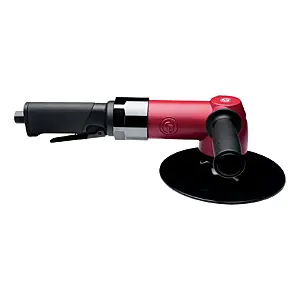
Cut, buff, and finish
Polishing wants low speed and torque, not rpm — the CP7201 handles spot repairs at 2,500 rpm and the CP7269P swings 7-8 in. pads for whole panels and marine gelcoat. The CP5518 and CP5318 advanced polishers are quote items we spec with CP.
Polisher · 3 in.
2,500 rpm · 3 in. pad
Small-area cut and buff on repaired panels.
Configuration
Polisher · 7-8 in.
2,600-5,000 rpm · 7-8 in. pad
Full-size polisher for whole-vehicle and marine gelcoat work.
Pad
Vertical Rotary Sander · 7 in.
7 in. pad · vertical rotary
Vertical-grip rotary for blending and finishing large panels.
Pad
Polisher · 5 in. Advanced
10,000 rpm · 5 in. pad
Advanced-line polisher; standard or long body. Call to quote.
Polisher · 3 in. Advanced
12,000 rpm · 3 in. pad
Compact advanced-line polisher. Call to quote.
Air Belt Sanders
Narrow belts reach weld seams, flanges, and tube that no disc can follow.
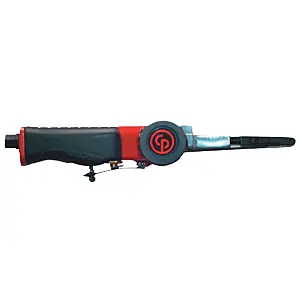
Seams, tube, and tight openings
A 3/8 or 3/4 in. belt gets into weld seams and between flanges, and wraps tube and pipe for finish work. The CP5080 industrial family runs seven belt-and-speed combinations; the PL05 is the heavy production machine for continuous seam grinding.
Belt Sander · Shop
20,000-22,000 rpm · 3/8 – 3/4 in. belt
Weld seams, flanges, and narrow openings a disc cannot reach.
Belt size
Belt Sander · Industrial
20,000-26,000 rpm · 7 versions
Industrial belt family across belt sizes; tool-only or kit.
Speed / Belt size
Belt Sander · Production
16,000 rpm · 18-7/8 in. belts
Continuous-duty production machine for fabrication finishing.
Belt size
Industrial Rotary & Angle Sanders
Governed industrial sanders from 2 to 9 in. pads for continuous finishing in metal fab, shipyards, and composite shops.
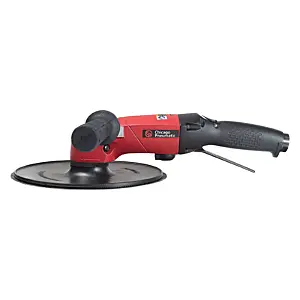
The CP3xxx finishing line
Same industrial platform as the CP3xxx grinders, fitted for sanding: governed motors that hold surface speed, pads to 9 in., and angle or inline geometry. When sanding is a production process rather than a prep step, this is the line.
Rotary Sander · 2-3 in.
15,000-25,000 rpm · 2-3 in. pad
Small-pad rotary for detail and spot finishing.
Pad
Rotary Angle Sander · 3 in.
9,000-20,000 rpm · 7 versions
Angle-head sander for panels, tanks, and weldment finishing.
Speed / Spindle
Rotary Angle Sander
2,000-3,000 rpm · heavy frame
Low-speed heavy sander for composite and gelcoat work.
Speed
Angle Sander · 5-7 in.
3,000-12,000 rpm · 5 in. pad
One-horsepower angle sander for fab-shop finishing.
Pad
Angle Sander · 5-7 in.
7,500-12,000 rpm · 5-7 in. pad
Premium industrial angle sander in three speed and pad builds.
Speed / Pad
Angle Sander · 7 in.
8,500 rpm · 7 in. pad
Single-size 7 in. industrial sander.
Spindle
Rotary Sander · 7-9 in.
6,000-7,700 rpm · 7-9 in. pad
Big-pad rotary for hull, tank, and plate finishing.
Pad
Rotary Angle Sander
8,500-12,000 rpm · 5-7 in. pad
Rotary-head version of the CP3650 platform. Call to quote.
Advanced-Line Orbital Sanders & Turbine Tools
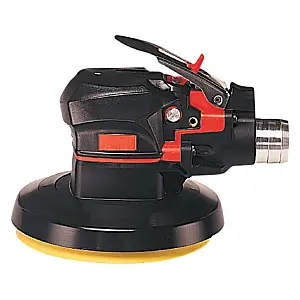
The CP53 and CP55 advanced orbital platforms and turbine sanders — configured to order for finishing cells and high-volume booths.
Spec-built finishing systems
These platforms build to spec: orbit size, pad size and attachment, vacuum type, and body length are all selectable, which is why we quote them rather than shelve one version. Tell us the finishing process and we will configure the tool with CP.
Advanced Orbital · CP53 Platform
10,000-12,000 rpm · 27 builds
Orbit, pad, vacuum, and body configured to your process. Call to quote.
Advanced Orbital · CP55 Platform
8,000-10,000 rpm · 22 builds
The premium orbital platform for finishing cells. Call to quote.
Vertical Sander
6,000 rpm · vertical head
Vertical-head industrial sander. Call to quote.
Turbine Angle Sander · 7 in.
8,500 rpm · turbine motor
Turbine power-to-weight for production sanding. Call to quote.
Air Sanders & Polishers — Common Questions
What is the difference between a random orbital sander and a rotary sander?
A rotary sander spins the pad in a pure circle — fast material removal, but it will leave swirl marks in paint. A random orbital adds an offset oscillation so no abrasive particle ever tracks the same path, which is what leaves a paint-ready finish. Prep and finish work is orbital; heavy removal and blending on metal is rotary.
PSA or hook-and-loop pads — which should I buy?
Hook-and-loop discs pull off and re-stick, so you can switch grits without wasting a disc — the right call for repair work with frequent grit changes. PSA (adhesive) discs sit flatter and cost less per disc, which suits production lines that run one grit all day. Most CP orbital families sell both versions at similar prices.
What does the vacuum option on an air sander actually do?
Three choices. Non-vacuum: dust goes where it wants. Self-vacuum: the sander uses its own exhaust to pull dust through the pad into a bag — better, portable. Central-vacuum: the sander connects to your shop extraction system — the cleanest booth air and what refinish operations spec. The pad must match: vacuum pads have holes, and so must the abrasive.
How much air does an air sander use?
A working 6 in. orbital wants roughly 10-15 CFM at 90 psi in continuous use — more than most home compressors deliver. Undersized air shows up as a sander that slows mid-panel and finishes unevenly. Check the CFM figure on the product page against your compressor, and call 1-888-883-5144 if the math looks close.
Why is my air sander leaving swirl marks?
Usually one of: a rotary sander doing an orbital job, a clogged or worn disc, too much downforce (let the abrasive cut, do not push), or a starved air supply dropping pad speed. If the tool is a true random orbital with fresh media and full air and still swirls, the pad bearing is worn — we stock service parts through the parts lookup.
Do you sell sanding discs and belts for these?
Yes — discs, belts, and sheets in abrasives, and replacement backing pads in grinding and sanding accessories. Match the pad hole pattern to your vacuum setup. Heavier stock removal belongs to the air grinders.
Need Help Picking a Sander or Polisher?
We stock the CP sander line in Denver and ship nationwide. Call for pad, vacuum, and abrasive advice for your booth or bench.