
Rhino Power Packs
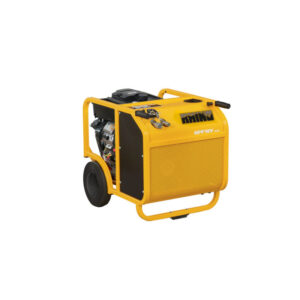
A hydraulic power pack is the engine room for handheld hydraulic tools: a portable pump unit that supplies oil at the flow and pressure a tool needs, so a crew can run a hydraulic breaker, a splitter, a cut-off saw, or a core drill with no carrier and no shop supply behind it. The CP PAC P13 delivers 5 to 8 gpm at up to 2,200 psi on a Honda gasoline engine; the CP PAC P9 holds 5 gpm at the same pressure with Power On Demand to cut fuel burn and noise. Atlas Copco’s LP 9-20P and LP 13-30 P idle their engines automatically between triggers, and the LP 18 Twin feeds two tools at once. Most packs ship flat-rate freight from Denver.
Showing the single result
Showing the single result
What a Power Pack Runs
One unit feeds a whole family of tools. Beyond breakers and drills, the same pack drives pick hammers and spike drivers, concrete crushers and metal shears, and hydraulic post drivers. What a pack will not do is replace a carrier — for boom-mounted production breaking, see excavator hydraulic breakers.
Flow, Pressure, and Outlets
Two numbers decide whether a pack and a tool get along: flow in gpm and working pressure in psi. The CP PAC P9 is rated at 5 gpm up to 2,200 psi and the PAC P13 at 5 to 8 gpm at the same pressure, which brackets most handheld hydraulic tools; Chicago Pneumatic describes its pack range as covering roughly 5 to 10 gpm at 2,000 to 2,500 psi. Outlet count matters too — a twin-outlet unit runs two tools, a single-outlet unit runs one.
Engine or Electric Drive
Engine-driven packs go anywhere. The Atlas Copco LP units idle the engine when the trigger is off and speed it up when the tool wakes, which saves fuel and noise, and each one carries a protective steel frame, folding handles, a lifting eye, and a return filter with a replacement indicator. For indoor demolition the Tehma PP700 runs a single-phase electric motor on 230V/110V household power, with a 5 hp petrol engine available where there is no supply.
Power Pack Comparison
Every pack on this page, listed by brand and drive type. Figures appear only where the manufacturer states them, so treat the notes column as a starting point and check the product page for full flow, pressure, reservoir capacity, and outlet detail before you pair a pack with a tool.
| Model | Brand | Drive | Notes |
|---|---|---|---|
| Atlas Copco LP 9-20P | Atlas Copco | Engine | Auto-idle regulation; fits a service van |
| Atlas Copco LP 13-30 P | Atlas Copco | Engine | Auto-idle regulation; Power On Demand |
| Atlas Copco LP 18 Twin | Atlas Copco | Engine | Twin tool outlets; wheels and handles |
| APP 18 Twin | Atlas Copco | Engine | Twin tool outlets |
| Chicago Pneumatic CP PAC P9 | Chicago Pneumatic | Honda gasoline | 5 gpm at up to 2,200 psi; Power On Demand |
| Chicago Pneumatic CP PAC P13 | Chicago Pneumatic | Honda gasoline | 5–8 gpm at up to 2,200 psi |
| Tehma PP600 | Tehma | See product page | Two-stage pump; takes the MM30 multiplier module |
| Tehma PP700 High Flow | Tehma | 1-phase electric or 5 hp petrol | High-pressure two-stage pump with cooling |
| Darda Hydraulic Power Pack | Darda | Four configurations | Runs every Darda splitter and combi shear |
Tehma units take the MM30 multiplier module, which lets one pack drive up to three SP400 or SP600 splitting cylinders at once. Compare the rest by maker: Atlas Copco power packs, Chicago Pneumatic power packs, Darda power packs, and Tehma power packs.
Common Questions
What is a hydraulic power pack? A portable unit that puts a prime mover, a hydraulic pump, an oil reservoir, and filtration on one frame and feeds a handheld tool through a hose pair. It is what lets a breaker, saw, or splitter work with no excavator and no shop hydraulics.
Is this the same as an electrical power pack? No. These are fluid-power units built to drive hydraulic tools, not battery packs or transformers. If you are shopping for a power supply for electrical gear, this is the wrong category.
Can one pack run two tools at once? A twin-outlet unit can, and the LP 18 Twin and APP 18 Twin are the two listed here. For splitting work the Tehma multiplier goes further, feeding up to three cylinders from a single pack.
How do I size a pack to my breaker? Match the tool’s rated flow and working pressure to the pack’s output and leave headroom. Under-flowing a tool costs blow energy; over-pressuring it costs seals. See hydraulic power packs for the full group.