
Chicago Pneumatic Air Drills
Ten pneumatic drill families from a $155 production pistol drill to geared machines that swing a 2 in. chuck. An air drill stalls against the work and restarts without burning up, which is why production and MRO crews run them where an electric drill would cook — and the ATEX-rated models go where electric cannot legally follow.
The short version
Speed follows hole size: small holes want rpm, big holes want torque. Production drilling in steel, aluminum, and stainless → the pistol production drills. Classified areas and explosive atmospheres → ATEX-rated drills. Holes above 5/8 in. → large-capacity geared drills. Every model is in the drills category; chucks and keys are in drilling accessories. Speed-to-hole-size questions: 1-888-883-5144.
Production Pistol Air Drills
1/4 to 1/2 in. chucks, 500-4,500 rpm — drilling steel, aluminum, and stainless all shift without a duty cycle.
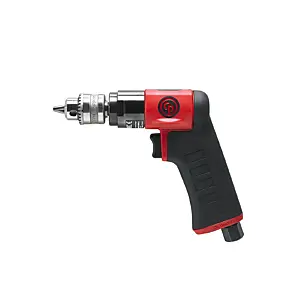
The everyday hole-makers
The CP7300/CP928X family is the production standard with eleven chuck-speed-reverse combinations; the CP879C angle-head version drills where a straight drill cannot stand. Lower speed means bigger holes: the 500 rpm versions turn hole saws and large bits the 3,000 rpm versions cannot.
Pistol Drill · 1/4-1/2 in.
600-3,000 rpm · 11 versions
One family, every chuck and speed combination — spec it to the hole.
11 configurations
Spec it on the product page — 11 buildable versions.
Pistol & Angle Drill · 3/8 in.
2,000-2,100 rpm · 3-4 ft-lb stall
Straight or angle-head for drilling inside structure and frames.
Handle
Pistol Drill · 3/8-1/2 in.
500-2,400 rpm · keyed or keyless
Lower speed, higher torque — larger holes and tougher material.
Chuck / Chuck
Pistol Drill · 3/8-1/2 in.
500-4,200 rpm · 2-16 ft-lb stall
Wide speed spread on one platform for mixed-material MRO work.
Chuck / Speed
Pistol Drill · 1/4-3/8 in.
500-4,500 rpm · 2-18 ft-lb stall
High-speed assembly drilling with fine feed control.
Speed
ATEX-Rated & Industrial Air Drills
Drills certified for explosive atmospheres — refineries, chemical plants, grain handling, and paint environments.
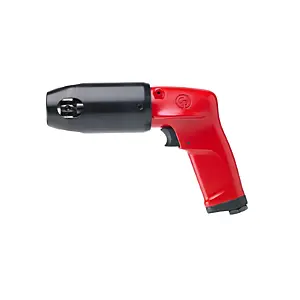
Classified areas and hard duty
An air motor makes no sparks and no heat signature, and the ATEX-certified CP1114R and CP1117 document it — the drill for classified zones where electric tools are prohibited. Both families also sell non-ATEX versions as premium industrial drills with chuck and speed options to 6,000 rpm.
Pistol Drill · ATEX Options
500-4,000 rpm · reversible
Reversible industrial drill; ATEX versions for classified areas.
Speed / ATEX
Pistol Drill · ATEX Options
500-6,000 rpm · 18 versions
The full industrial platform — every speed, chuck, and ATEX combination.
18 configurations
Spec it on the product page — 18 buildable versions.
Large-Capacity Geared Air Drills
Geared-down torque for hole saws, annular cutters, and twist drills to 2 in. — steel fabrication, shipyards, and field machining.
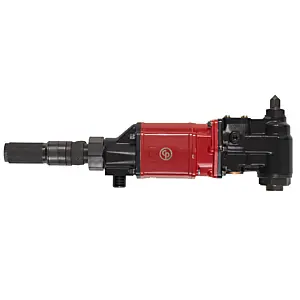
Holes above 5/8 in.
Below about 500 rpm, drilling becomes a torque problem. These geared machines turn 140-800 rpm with stall torques to 289 ft-lb — the CP1720R swings a 2 in. chuck. All three want two hands and a firm brace; the torque that drives a 2 in. bit will also spin the operator.
Geared Drill · 5/8 in.
800 rpm · 25 ft-lb stall
The step up when a 1/2 in. drill runs out of torque.
Chuck
Geared Drill · 7/8-1-1/4 in.
380-480 rpm · 58-145 ft-lb stall
Reversible geared drill for structural and shipyard holes.
Chuck
Geared Drill · to 2 in.
140-430 rpm · 59-289 ft-lb stall
The biggest chuck in the line — hole saws and annular cutters included.
Chuck
Air Drills — Common Questions
Why use an air drill instead of a cordless drill?
Three reasons: an air drill stalls harmlessly and restarts instead of burning up, it makes full power all shift with no batteries to rotate, and it is lighter than an equivalent-torque electric. In production drilling — hundreds of holes a day — those add up to the air tool outlasting several cordless drills. The trade is the hose and the compressor.
What speed drill do I need for what hole size?
Rough rule for steel with twist drills: 1/4 in. holes run happily at 2,000-3,000 rpm; 3/8 in. around 1,200-1,800; 1/2 in. wants 800-1,200; and anything above 5/8 in. belongs on a geared low-speed drill. Too fast burns the bit tip, too slow wastes cycle time. The multi-speed families let you buy the speed the work actually needs.
What does the ATEX rating on the CP1114R and CP1117 mean?
ATEX certification documents that the tool is safe for specified explosive-atmosphere zones — refineries, chemical plants, grain elevators, paint areas. The air motor makes no sparks and no hot surfaces, and the certification is the paperwork your safety officer needs. Order specifically the ATEX version; the standard versions of the same drills do not carry the marking.
Keyed or keyless chuck?
Keyless is faster for bit changes and fine for holes to about 3/8 in. Keyed chucks grip harder and survive the torque of bigger bits and hole saws — which is why the geared drills are keyed. Production cells drilling one size all day usually run keyed for grip; MRO carts run keyless for speed. Replacement chucks and keys are in drilling accessories.
How much air do these drills need?
The pistol drills typically want 4-8 CFM at 90 psi in working use; the geared large-capacity machines want substantially more under load. As with all air tools, check the CFM on the product page against your compressor — a starved drill loses the low-end torque that big holes depend on. Call 1-888-883-5144 to check your setup.
Need Help Matching Drill Speed to Hole Size?
Tell us the material and hole diameter and we will spec the right speed and chuck. All ten families ship from Denver stock.