
Grinders
Air grinders take metal off fast — dressing welds, deburring castings, grinding parting lines, and cutting with an abrasive wheel — and they keep working in the heat, dust, and duty cycles that stall an electric tool. Chicago Pneumatic builds them in six shapes: straight and angle die grinders, angle grinders, vertical grinders for foundry and weld work, straight wheel grinders, pencil grinders for die and mold detail, and the CP3T30 angle turbine grinder with an autobalancer to hold vibration down. Motors run from the 0.54 hp (400 W) CP860 up to the 4.5 hp (3,400 W) CP3340 vertical grinder. Feed them from the abrasives range, clean the air with a filter, regulator and lubricator, and see the whole line on the CP air grinders page. For finishing rather than cutting, cross to sanders and polishers. In-stock items ordered by 4 PM ET ship the same day from Denver.
Showing all 4 resultsSorted by popularity
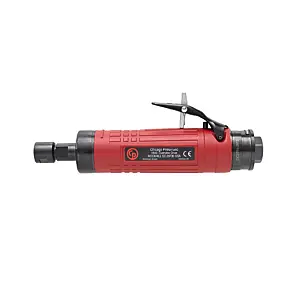
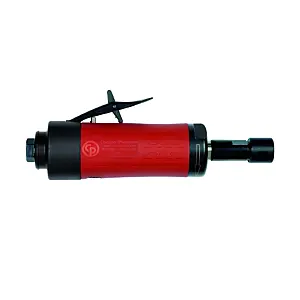
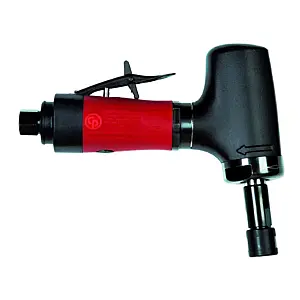
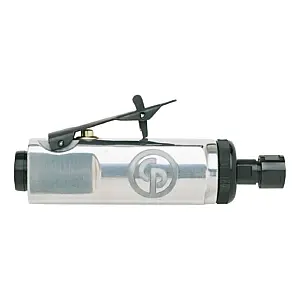
Showing all 4 resultsSorted by popularity
Industrial Grinders vs. General-Maintenance Grinders
CP splits this line in two, and the split decides your air bill. The industrial catalog — CP3000 through CP3850 — runs 0.12 to 4.56 hp on 5.5 to 110 CFM at 90 psi, with governed motors and steel housings on 1,000 to 2,000 hour service intervals; the redesigned CP3650 angle grinder is rated at 2,500 hours on the gear. The general-maintenance line — CP854, CP860, CP875, CP7500, CP9104, CP9120 — runs 0.05 to 1.26 hp on 2.1 to 40 CFM. Lighter tools, smaller air bill, sized for a shop compressor rather than a production cell.
Die, Angle, Vertical & Straight
Die grinders spin a 1/4 in. or 6 mm carbide burr for weld cleanup, porting, and mold work; the CP875 puts a 90° head into tight areas and the CP9104 pencil grinder handles fine detail. Angle grinders take a 4, 7, or 9 in. wheel for stock removal and cutting. Vertical grinders such as the CP3330 lay a 6 to 9 in. disc flat for weld prep and foundry cleaning. Straight wheel grinders like the CP3249 reach inside fabrications with a 6 or 8 in. wheel.
Compare CP Air Grinders
Motor output and wheel size set how fast a grinder cuts and how much air it drinks. Figures below are CP’s published maximums for each series.
| Model | Style | Max motor | Wheel size or free speed |
|---|---|---|---|
| CP3000 Series | Straight die | 0.7 hp (500 W) | 30,000 rpm |
| CP3040 Series | Angle, steel housing | 0.7 hp (520 W) | 4 in. (100 mm), 13,000 rpm |
| CP3119 Series | Straight wheel | 1.2 hp (900 W) | 3 in. (80 mm) |
| CP3550 Series | Angle | 1.5 hp (1,100 W) | — |
| CP3750 Series | Angle | 2.2 hp (1,640 W) | — |
| CP3850 Series | Angle, heavy duty | — | 7 & 9 in. (180, 230 mm) |
| CP9113 Series | Straight die, steel | 1 hp (750 W) | 25,000 rpm |
Filter the range above by style and wheel size in the sidebar, or work down from the industrial tools hub.
Air Supply, Abrasives & Wear
Air inlets on this line run 1/8 to 1/2 in. at 90 psi maximum working pressure, so a 4-1/2 in. angle grinder and a 9 in. vertical need very different hose and compressor. What wears is predictable: the bevel gear, the collet, the governor, and the abrasive. Keep an oiler in the line, stock grinding and sanding accessories, and pull exploded views from the parts and diagrams hub.
Common Questions
What is a turbine grinder? CP builds one turbine line, the CP3T30 series, rated for high material removal and an excellent power-to-weight ratio in a compact body, with an autobalancer that damps vibration.
Is the CP860 a die grinder? Yes — the CP860 series is a 1/4 in. general-maintenance die grinder with a 0.54 hp (400 W) motor, adjustable speed regulator, and lock-off throttle, built for tire cleaning, porting, and high-speed grinding.
How big a compressor does an air grinder need? Size to the tool, not the average: CP’s industrial grinders draw 5.5 to 110 CFM at 90 psi and the maintenance models 2.1 to 40 CFM, and a grinder runs continuously rather than in bursts.
Do you carry grinder parts? CP catalogs tune-up kits and spare parts across this line. Send the series and the item number off the tool tag and we will pull the diagram.